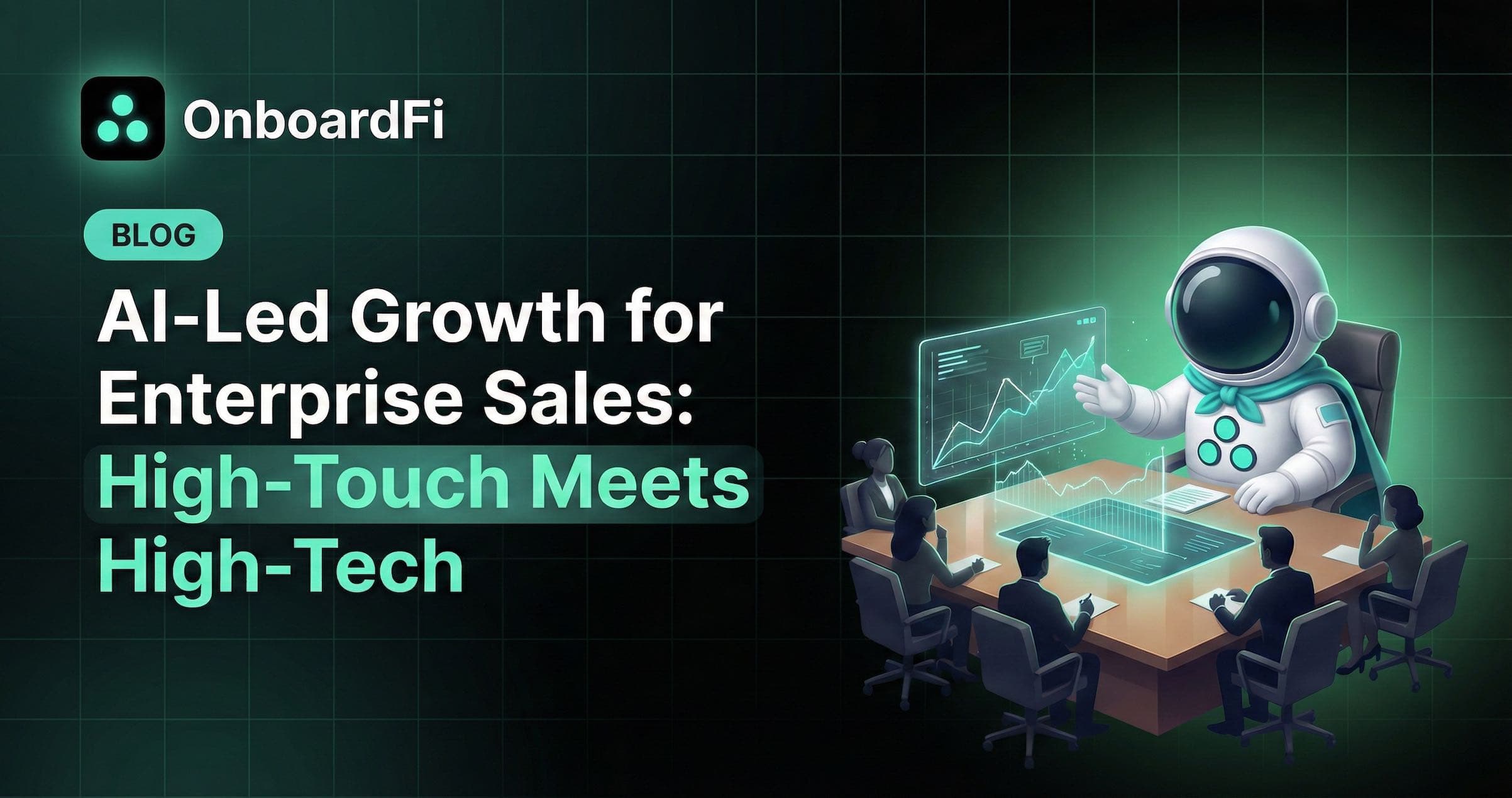
AI-Led Growth has proven its power in velocity sales. AI SDRs book meetings around the clock, AI demos deliver instant product experiences, and conversion rates soar. But a persistent question lingers in boardrooms and sales floors alike: can AI-Led Growth work for enterprise sales?
The skepticism is understandable. Enterprise deals are not won with speed alone. They involve six to ten decision-makers on average, sales cycles that stretch across months or quarters, and procurement processes that demand nuance, patience, and deep relationship-building [1]. The idea of an AI agent navigating a complex org chart or handling a CFO's pointed questions about ROI can seem far-fetched.
Yet the data tells a different story. According to McKinsey, companies that have deployed AI in their sales processes have seen revenue increases of 3–15% and sales ROI improvements of 10–20% [2]. Gartner predicts that by 2028, 60% of B2B seller work will be executed through conversational AI and automation, up from less than 5% in 2023 [3]. The enterprise is not immune to this transformation—it is at the center of it.
The key is understanding that AI-Led Growth for enterprise sales is not about replacing high-touch with high-tech. It is about fusing them into something more powerful than either alone.
Why Enterprise Sales Is Different
Before exploring how AI-Led Growth adapts to enterprise contexts, it is worth examining what makes enterprise sales fundamentally distinct from SMB or velocity motions.
| Dimension | SMB / Velocity Sales | Enterprise Sales |
|---|---|---|
| Decision-Makers | 1–2 individuals | 6–10+ stakeholders across functions |
| Sales Cycle | Days to weeks | Months to quarters |
| Deal Size | $1K–$50K ACV | $100K–$1M+ ACV |
| Buying Process | Individual or small team decision | Formal procurement, legal review, security audits |
| Relationship Depth | Transactional | Strategic partnership |
| Customization | Limited | High (integrations, SLAs, custom terms) |
In velocity sales, the goal is to remove friction and accelerate time-to-close. In enterprise sales, the goal is to build consensus across a complex buying committee while demonstrating strategic value. These are fundamentally different motions, and AI-Led Growth must adapt accordingly.
The Three Pillars of AI-Led Growth for Enterprise
Successful AI-Led Growth in enterprise contexts rests on three pillars: intelligent qualification, stakeholder orchestration, and human-AI collaboration. Each pillar leverages AI's strengths while preserving the high-touch elements that enterprise buyers demand.
Pillar 1: Intelligent Qualification at Scale
Enterprise sales teams are perpetually resource-constrained. Strategic account executives are expensive, and their time is best spent on deals with genuine potential. Yet traditional qualification methods—manual research, discovery calls, and gut instinct—are slow and inconsistent.
AI agents transform this dynamic by conducting deep, real-time qualification before a human ever engages. Modern AI SDRs can:
- Enrich account data instantly: Pulling firmographic, technographic, and intent signals from multiple sources to build a complete picture of the prospect.
- Identify buying committee members: Mapping organizational structures and surfacing likely stakeholders based on role, seniority, and historical patterns.
- Score deal potential: Assessing fit against ideal customer profile criteria with far greater consistency than manual methods.
- Engage in preliminary discovery: Asking intelligent questions to understand pain points, timeline, and budget parameters.
The result is that when a human AE enters the conversation, they are armed with context that would have taken hours to assemble manually. A 2024 study found that AI-powered lead qualification can reduce time spent on unqualified leads by up to 50%, allowing sales teams to focus on opportunities with genuine potential [4].
Pillar 2: Stakeholder Orchestration
The buying committee is the defining challenge of enterprise sales. A champion in the product organization may love your solution, but the deal stalls when procurement raises security concerns, finance questions the ROI, or IT worries about integration complexity. Traditional sales motions struggle to maintain momentum across these disparate stakeholders.
AI agents excel at orchestration—the systematic engagement of multiple stakeholders with personalized, relevant content and interactions. This manifests in several ways:
Multi-threaded engagement: AI agents can simultaneously nurture relationships with multiple stakeholders, ensuring that no member of the buying committee goes dark. While your AE focuses on the economic buyer, an AI agent can keep the technical evaluator engaged with relevant case studies, answer the security team's preliminary questions, and surface ROI calculators for the finance stakeholder.
Personalized content delivery: Enterprise deals require different messages for different audiences. The CTO cares about architecture and scalability. The CFO cares about total cost of ownership and payback period. The end-user champion cares about ease of adoption. AI agents can dynamically tailor content and messaging to each stakeholder's priorities, a task that would overwhelm a human seller managing dozens of relationships.
Meeting preparation and follow-up: AI can synthesize information from across stakeholder interactions to prepare comprehensive briefings before key meetings and generate personalized follow-up materials afterward. This ensures continuity and demonstrates attentiveness that builds trust.
Pillar 3: Human-AI Collaboration
The most critical pillar is also the most nuanced. AI-Led Growth for enterprise sales is not about removing humans from the equation—it is about deploying human expertise at the moments of highest leverage.
Consider the enterprise sales cycle as a series of interactions, each with varying degrees of complexity and strategic importance:
| Interaction Type | Complexity | AI Role | Human Role |
|---|---|---|---|
| Initial inquiry response | Low | Primary | Oversight |
| Technical Q&A | Medium | Primary with escalation | Available for edge cases |
| Discovery call | High | Preparation and follow-up | Primary |
| Executive presentation | Very High | Research and content support | Primary |
| Contract negotiation | Very High | Data analysis and benchmarking | Primary |
| Relationship building | High | Scheduling and logistics | Primary |
In this model, AI handles the high-volume, lower-complexity interactions that would otherwise consume human bandwidth, while human sellers focus on the strategic moments that require empathy, creativity, and executive presence. The AI is not a replacement; it is a force multiplier.
Research from Harvard Business Review suggests that this collaborative model can increase sales productivity by 15–20% while simultaneously improving customer satisfaction scores [5]. The key is seamless handoffs—ensuring that when a human enters the conversation, they have full context and the prospect experiences continuity rather than repetition.
The Enterprise AI-Led Growth Playbook
Implementing AI-Led Growth for enterprise sales requires a deliberate, phased approach. Organizations that attempt to automate everything at once often create disjointed experiences that erode trust. Instead, successful implementations follow a progressive playbook.
Phase 1: Augment Research and Preparation
Begin by deploying AI to enhance the research and preparation that precedes human engagement. This is low-risk and high-value:
- Automated account research and briefing documents
- Stakeholder mapping and org chart construction
- Competitive intelligence gathering
- Meeting preparation summaries
This phase demonstrates value quickly while building organizational comfort with AI-assisted selling.
Phase 2: Automate Initial Engagement
Once research augmentation is established, extend AI to initial prospect engagement:
- AI SDR for inbound qualification and meeting booking
- Automated responses to preliminary inquiries
- Intelligent routing based on deal characteristics
- Initial discovery conversations for lower-tier prospects
The key is establishing clear escalation criteria so that high-potential enterprise opportunities are quickly elevated to human sellers.
Phase 3: Orchestrate the Buying Committee
With initial engagement automated, deploy AI for multi-stakeholder orchestration:
- Parallel nurture streams for different buying committee members
- Personalized content delivery based on stakeholder role
- Automated check-ins and re-engagement sequences
- Stakeholder sentiment monitoring and risk alerts
This phase requires tight integration with your CRM and sales engagement platforms to maintain a unified view of the opportunity.
Phase 4: Continuous Intelligence
The most advanced implementations use AI as a continuous intelligence layer throughout the deal:
- Real-time coaching suggestions during calls
- Dynamic pricing and proposal optimization
- Win/loss prediction and deal health scoring
- Competitive response recommendations
At this stage, AI becomes an embedded partner for every enterprise seller, augmenting their judgment with data-driven insights at every turn.
Common Pitfalls and How to Avoid Them
The path to AI-Led Growth for enterprise sales is not without hazards. Organizations that have stumbled tend to share common mistakes:
Over-automation of high-stakes interactions: Enterprise buyers expect and deserve human attention for significant decisions. Automating executive briefings or contract negotiations signals that you do not value the relationship. Reserve AI for the interactions where speed and scale matter more than personal touch.
Inconsistent handoffs: Nothing erodes trust faster than a prospect having to repeat information they already shared with an AI agent. Ensure that all AI interactions are logged, summarized, and surfaced to human sellers before they engage.
Generic personalization: Enterprise stakeholders are sophisticated buyers who can detect superficial personalization. AI-generated content must be genuinely tailored to the specific context, industry, and challenges of each account—not just mail-merged with a company name.
Ignoring change management: Sales teams that feel threatened by AI will resist adoption. Position AI as a tool that eliminates tedious work and amplifies their effectiveness, not as a replacement for their skills.
The Future: Heterogeneous Teams at Scale
The ultimate vision of AI-Led Growth for enterprise sales is the heterogeneous team—a seamless blend of human sellers and AI agents working in concert across every stage of the customer journey. In this model:
- AI agents handle the breadth of engagement, ensuring no stakeholder is neglected and no signal is missed.
- Human sellers provide the depth of relationship, bringing empathy, creativity, and strategic thinking to the moments that matter most.
- The handoffs between them are invisible to the buyer, who experiences a unified, attentive, and responsive sales motion.
This is not a distant future. Companies like Salesforce, HubSpot, and a wave of emerging startups are building the infrastructure to make heterogeneous teams a reality. The organizations that master this model will enjoy a structural advantage in enterprise sales: the ability to deliver high-touch experiences at a scale that purely human teams cannot match.
Conclusion: High-Touch and High-Tech Are Not Opposites
The false dichotomy between high-touch enterprise sales and high-tech AI automation has held back too many organizations. The reality is that AI-Led Growth and relationship-driven enterprise selling are not in tension—they are complementary.
AI handles the scale. Humans provide the soul. Together, they create a sales motion that is more responsive, more personalized, and more effective than either could achieve alone.
At OnboardFi, we believe this fusion extends beyond the sale itself. Our platform ensures that the seamless, AI-enhanced experience continues through onboarding and customer success, so the trust built during the sales process compounds into long-term partnership. The enterprise buyers of 2026 expect nothing less.
References
[1] Gartner. (2024). The New B2B Buying Journey. Retrieved from Gartner research publications.
[2] McKinsey & Company. (2024). The State of AI in Sales. Retrieved from McKinsey Global Institute.
[3] Gartner. (2024). Gartner Predicts 60% of B2B Seller Work Will Be Executed Through Conversational AI by 2028. Retrieved from Gartner press releases.
[4] Forrester Research. (2024). The ROI of AI-Powered Sales Qualification. Retrieved from Forrester research publications.
[5] Harvard Business Review. (2024). How AI Is Transforming the Sales Function. Retrieved from HBR.org.