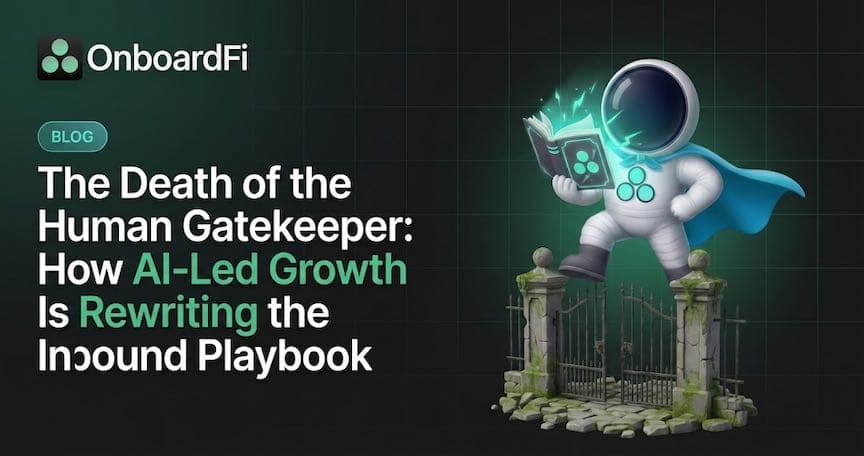
For years, the B2B buyer's journey has started with a universal act of digital surrender: filling out a contact form. You serve up your name, email, and company details, then cast your request into the void, hoping for a timely response. More often than not, you wait. And wait. This is the friction-filled reality of the human-gated inbound model—a model that is now being systematically dismantled by a new paradigm: AI-led Growth.
The era of the human gatekeeper is over. As we move into 2026, the most forward-thinking companies are no longer forcing high-intent prospects to wait in a queue. Instead, they are deploying intelligent AI agents that engage, qualify, and convert buyers the moment they arrive on the digital doorstep. This isn't just an incremental improvement; it's a fundamental revolution in the inbound playbook, and it's a core tenet of AI-led Growth.
The Friction Tax: Why the Old Inbound Model Kills AI-led Growth
The traditional inbound process is a relic of a pre-AI world. It operates on the assumption that a buyer's time is less valuable than a seller's, a concept directly at odds with the principles of AI-led Growth. Consider the all-too-common workflow:
- The Form: A prospect with high intent lands on your website and fills out a form.
- The Black Hole: The lead is routed into a CRM, often triggering a cascade of internal notifications.
- The Round Robin: The lead is assigned to a sales rep, who may or may not be available.
- The Delay: Hours, or even days, can pass before the sales rep attempts to make contact.
In that critical window between expressed intent and human contact, the deal dies a slow death. The prospect gets distracted, finds a competitor with a more responsive process, or simply loses interest. This "friction tax" is a silent conversion killer, and it's a direct consequence of relying on human gatekeepers to manage inbound interest—a major roadblock to achieving AI-led Growth.
The SaaStr Case Study: A Masterclass in AI-led Growth
At SaaStr AI London 2025, CEO Jason Lemkin and Chief AI Officer Amelia laid out a powerful case for an AI-led Growth strategy focused on the inbound experience. They detailed how they replaced their traditional form-and-wait process with an AI agent from Qualified, which sits on their website and engages visitors in real-time. The results were a staggering demonstration of AI-led Growth in action.
In just a few months, the AI agent booked over 130 qualified meetings directly onto the sales team's calendars [1]. A significant portion of these meetings were booked overnight, allowing the account executives to wake up to a full schedule of appointments rather than a list of cold leads to chase. This is the power of an AI workforce that operates 24/7, providing instant gratification to prospects and a steady stream of qualified opportunities to the sales team—a core component of a successful AI-led Growth model.
| Metric | Result | Impact on AI-led Growth |
|---|---|---|
| Meetings Booked | 130+ in ~3 months | Automated pipeline generation |
| Availability | 24/7/365 | Conversion of overnight and weekend traffic |
| Buyer Preference | 85% prefer chat to voice/phone | Alignment with modern communication habits |
| Time-to-Engage | Instant | Elimination of the "friction tax" |
This real-world example of AI-led Growth demonstrates a profound shift in buyer behavior. Prospects, given the choice, overwhelmingly prefer the immediacy and efficiency of an AI agent over the delay and uncertainty of a human-gated process. The data shows that 85% of users prefer to interact with an AI via chat, highlighting the demand for asynchronous, on-demand communication [1].
The New Role of the Human in an AI-led Growth World
This shift does not make humans obsolete; it elevates their role within an AI-led Growth framework. In an AI-driven inbound model, the sales team is freed from the monotonous task of manual qualification and scheduling. Instead of acting as gatekeepers, they become strategic advisors, focusing their time and energy on high-value activities that complement the AI-led Growth engine:
- Complex Deal Navigation: Engaging with qualified prospects to understand their unique challenges and architect sophisticated solutions.
- Relationship Building: Fostering long-term partnerships with key accounts.
- Strategic Closing: Focusing on the art of the close, rather than the science of the follow-up.
The AI agent handles the top of the funnel with relentless efficiency, ensuring that every inbound lead is engaged and qualified, while the human sales team is reserved for the moments that require empathy, creativity, and strategic thinking. This is the essence of a Heterogeneous Team—a symbiotic partnership between human and machine that drives unprecedented AI-led Growth and efficiency [1].
The Future is Instant: Are You Ready for AI-led Growth?
The death of the human gatekeeper is not a distant future; it is a present reality driven by the principles of AI-led Growth. Companies that cling to the old, friction-filled inbound model will find themselves outmaneuvered by competitors who have embraced the power of AI to deliver an instant, gratifying, and efficient buyer experience.
At OnboardFi, we are building for this new reality. We believe that a true AI-led Growth journey shouldn't end at the first touchpoint. Our platform extends the seamless, AI-driven experience from initial engagement through onboarding and customer success, creating a unified and intelligent customer lifecycle. The question is no longer if you should adopt an AI-led Growth strategy, but how quickly you can make the transition. The future of growth belongs to those who are ready to meet their buyers in the now.
References
[1] SaaStr. (2025). How to Use AI to Hyper-Customize Go-To-Market at Scale with SaaStr's CEO and Chief AI Officer. SaaStr AI London 2025.