Every B2B website has a chat widget. That little bubble in the bottom-right corner, waiting for someone to click it. Most visitors never do. And the ones who do? They type "pricing" or "does this integrate with Salesforce," get a canned response, and leave.
Text chatbots were supposed to fix the form-and-wait problem. They did, partially. They respond fast. They work 24/7. But for lead qualification, they miss something that matters more than speed: the depth of a real conversation.
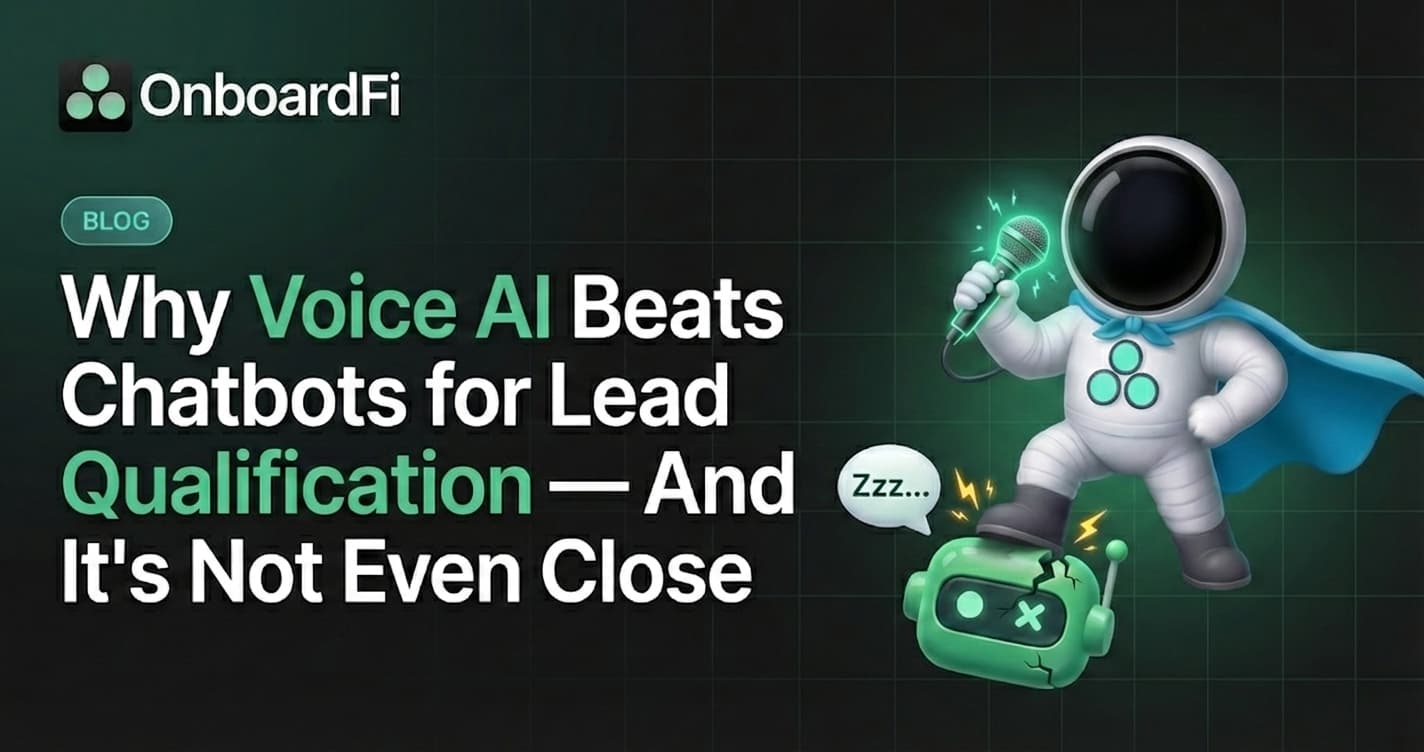
Voice AI changes the equation. When a visitor talks instead of types, you get qualification data that text chat cannot capture. Tone of voice. Urgency. The follow-up questions that reveal whether someone is browsing or buying. This post breaks down the data behind why voice-first engagement converts better than text chatbots for B2B lead qualification, and why the gap is wider than most teams realize.
TL;DR
- Text chatbots see 35-40% engagement rates among visitors who encounter them, and abandonment during multi-step qualification is common
- Voice conversations build trust in seconds through tonal cues that text cannot carry. Research in the Journal of Experimental Psychology found voice exchanges create stronger social bonds than text-based communication
- AI voice agents produce 36% higher meeting conversion rates compared to generic outreach, and organizations report 43% higher win rates with voice-first systems
- Voice captures more qualification data per minute: a 3-minute spoken conversation covers what takes 8-12 text exchanges
- The combination of voice and video (an AI avatar the visitor can see) increases perceived trustworthiness and engagement duration
The Text Chatbot Problem: Fast but Shallow
Text chatbots solve a real problem. They respond instantly. They replace static forms. And they work while your team sleeps. Chatbot-led funnels convert 2.4x higher than traditional web forms, and 64% of businesses using AI chatbots report an increase in qualified leads [1].
So what's the issue?
The issue is qualification depth. Text chatbots are good at routing. They are good at answering FAQ-style questions. They are not good at the thing that matters most for B2B qualification: understanding whether a prospect is a real buyer and what they actually need.
Here is why.
Low engagement, high abandonment
Industry benchmarks put chatbot engagement rates at 35-40% among visitors who encounter the widget [2]. That means 60-65% of visitors who see your chat bubble ignore it entirely. Of the ones who do engage, a meaningful percentage abandon the conversation before completing qualification. The typical pattern: visitor types a question, gets a response, types another question, gets a longer response, loses patience, closes the tab.
Text-based qualification requires the visitor to do the work. They have to formulate their question. Type it out. Read the response. Formulate a follow-up. Type that out too. Each step is friction, and each step is an exit opportunity.
Text strips context from the conversation
When someone types "we're evaluating tools for our sales team," you get seven words. When someone says the same thing, you get seven words plus tone (are they frustrated? excited? skeptical?), pace (are they in a rush or browsing casually?), and the natural follow-up that flows from a spoken conversation.
Text flattens communication into its lowest-bandwidth form. For support tickets and order tracking, that's fine. For qualifying a $50K deal? You're leaving signal on the table.
Multi-step qualification feels like an interrogation
Try qualifying a B2B lead through text chat. You need company size, use case, timeline, budget range, and decision-making authority. That's five questions minimum. In a text chat, five questions feels like filling out a form with extra steps. In a voice conversation, those same five data points come out naturally within the first two minutes.
Why Voice Converts Better: The Research
Trust forms faster through voice
Human brains are wired to assess trustworthiness through vocal cues. Research from the Journal of Experimental Psychology: General found that voice and video exchanges create significantly stronger social bonds than text-based communication [3]. People judge trustworthiness within the first few seconds of hearing a voice, based on tonal qualities like warmth, confidence, and pace.
This is not abstract psychology. It directly affects conversion. A visitor who trusts the experience stays longer, shares more information, and moves further through qualification. A visitor who doesn't trust the experience closes the tab. Voice creates trust in seconds. Text chatbots have to earn it over multiple exchanges.
Voice agents book more meetings
The performance data is clear. AI-generated, personalized voice interactions achieve 36% higher meeting conversion rates compared to generic approaches [4]. Organizations using AI voice systems report 28% more qualified meetings booked within six months, a 42% reduction in cost per lead, and 43% higher win rates compared to teams relying on fragmented tools [4].
Compare that to text chatbot benchmarks: 23% conversion lift over static forms and 2.4x improvement over web forms [1]. Both are solid numbers. But voice outperforms text on the metric that matters most for B2B sales: qualified pipeline.
More data captured per minute
A spoken conversation moves at 125-150 words per minute. A text chat exchange averages 40-60 words per minute when you account for typing speed, reading time, and response latency. That's a 2-3x throughput difference before you factor in the non-verbal signals that voice carries.
In practical terms: a 3-minute voice conversation captures what takes 8-12 text exchanges to cover. The visitor finishes the interaction feeling like they had a conversation, not like they filled out a questionnaire.
Voice + Video: The Multiplier Effect
Adding a visual component to voice changes the dynamic again. When a visitor sees an AI avatar speaking to them, the interaction shifts from "using a tool" to "talking to someone." Northwestern University research on video communication found that visual presence increases perceived trustworthiness and engagement compared to voice-only or text-only interactions [5].
OnboardFi's Embedded Agent uses this approach: voice-first conversation with a video avatar. The visitor speaks to an AI that they can see, hear, and interact with in real-time. Nine avatar personalities with distinct appearances and voices. No text input field. No typing. Just a conversation.
This is a deliberate design choice, not a limitation. Removing the text fallback forces the interaction into its highest-bandwidth form. Every visitor who engages is having a real conversation, not sending a quick "pricing?" message and hoping for a PDF link.
Head-to-Head: Voice AI vs. Text Chatbot for Qualification
| Dimension | Voice AI | Text Chatbot |
|---|---|---|
| Trust building | Seconds (tonal cues, avatar presence) | Minutes to never (text only) |
| Data per minute | 125-150 words spoken + vocal signals | 40-60 words typed, no tonal context |
| Qualification depth | Natural conversation covers 5+ data points in 2-3 minutes | 5+ questions feels like an interrogation |
| Meeting conversion lift | 36% higher than generic approaches | 23% lift over static forms |
| Win rate impact | 43% higher with voice-first systems | Not isolated in available data |
| Visitor effort | Low (just talk) | Higher (type, read, type, read) |
| Engagement commitment | High (voice requires active participation) | Low (easy to multitask or abandon) |
| Emotional signal capture | Tone, urgency, enthusiasm, hesitation | Limited to word choice and emoji |
When Text Chat Still Makes Sense
Voice-first doesn't mean voice-only-forever-for-everything. Text chat works well in specific scenarios:
- Support and troubleshooting where the visitor needs to paste error messages, share URLs, or reference documentation
- Quick transactional queries like checking order status or account details
- Environments where speaking aloud isn't practical (open offices, public spaces, accessibility needs)
But for B2B lead qualification? The job is to determine whether a visitor is a good fit, what they need, and how urgent their problem is. That job requires the richest communication channel available. Text chat is a compromise. Voice is the real thing.
The Strategic Case for Voice-First
Here is the uncomfortable truth for teams running text chatbots: you are qualifying leads through the lowest-bandwidth channel on your website.
Your pricing page has rich visuals. Your product demos have video. Your case studies have data and narrative. Then a high-intent visitor arrives, clicks your chat widget, and you drop them into a text box. The experience gap between your marketing content and your qualification tool is enormous.
Voice-first qualification closes that gap. It matches the richness of the rest of your website experience. And it gives you something text never can: the ability to hear whether a prospect is genuinely interested or just kicking tires.
Teams that treat voice AI as a strategic channel rather than a cost center are seeing the results: 43% higher win rates, 37% faster sales cycles, and qualification data that tells their sales team not just what a prospect said, but how they said it [4].
For an AI SDR that qualifies leads through voice and video conversation 24/7, that difference is the competitive edge. Your text chatbot competes with every other text chatbot. A voice AI agent competes with nobody, because almost no one else is doing it yet.
Explore how voice-first qualification fits into a broader AI-led sales workflow, or see how it connects to automated product demos for a full-funnel approach.
FAQ
Is voice AI better than a chatbot for sales?
For B2B lead qualification, yes. Voice AI captures richer data per interaction (tone, urgency, and natural follow-up questions that text misses), builds trust faster through vocal cues, and produces 36% higher meeting conversion rates. Text chatbots remain effective for support queries and simple transactional interactions where typing is more practical.
What is the conversion rate for AI chatbots in B2B?
AI chatbots increase conversion rates by approximately 23% over static content and convert 2.4x higher than traditional web forms. Organizations using AI voice agents report 36% higher meeting conversion rates and 43% higher win rates, suggesting voice-first approaches outperform text for high-intent qualification scenarios.
Can voice AI replace chatbots on my website?
Voice AI replaces text chatbots for lead qualification and sales conversations. For support tickets, order tracking, and text-heavy interactions (pasting error codes, sharing URLs), text-based tools still add value. The strongest approach uses voice AI for qualification and sales, with text-based support for scenarios where typing is the better modality.
How does voice AI qualify leads differently than a chatbot?
A text chatbot qualifies leads through a sequence of typed questions and responses, which often feels like filling out a form. Voice AI qualifies through natural conversation where the AI asks questions, listens to answers, and picks up on vocal cues (enthusiasm, hesitation, urgency) that text cannot carry. A 3-minute voice conversation typically covers what takes 8-12 text chat exchanges to capture.
References
[1] Tidio. (2026). 80+ Chatbot Statistics & Trends in 2026.
[2] Calabrio. (2025). The Chatbot Performance Metrics Every Team Should Be Measuring.
[3] Kumar, A. & Epley, N. (2020). It's surprisingly nice to hear you: Misunderstanding the impact of communication media can lead to suboptimal choices of how to connect with others. Journal of Experimental Psychology: General.
[4] MarketsandMarkets. (2026). Voice AI in 2026: Can AI Agents Successfully Cold Call? The Complete Guide.
[5] Bos, N., Olson, J., Gergle, D., Olson, G., & Wright, Z. (2002). Effects of four computer-mediated communications channels on trust development. Proceedings of the SIGCHI Conference on Human Factors in Computing Systems.
Your website visitors don't want to type. They want to talk. OnboardFi's Embedded Agent runs voice-first, video-native conversations with website visitors 24/7, qualifying leads through natural dialogue instead of text exchanges. See it in action or check pricing to get started.