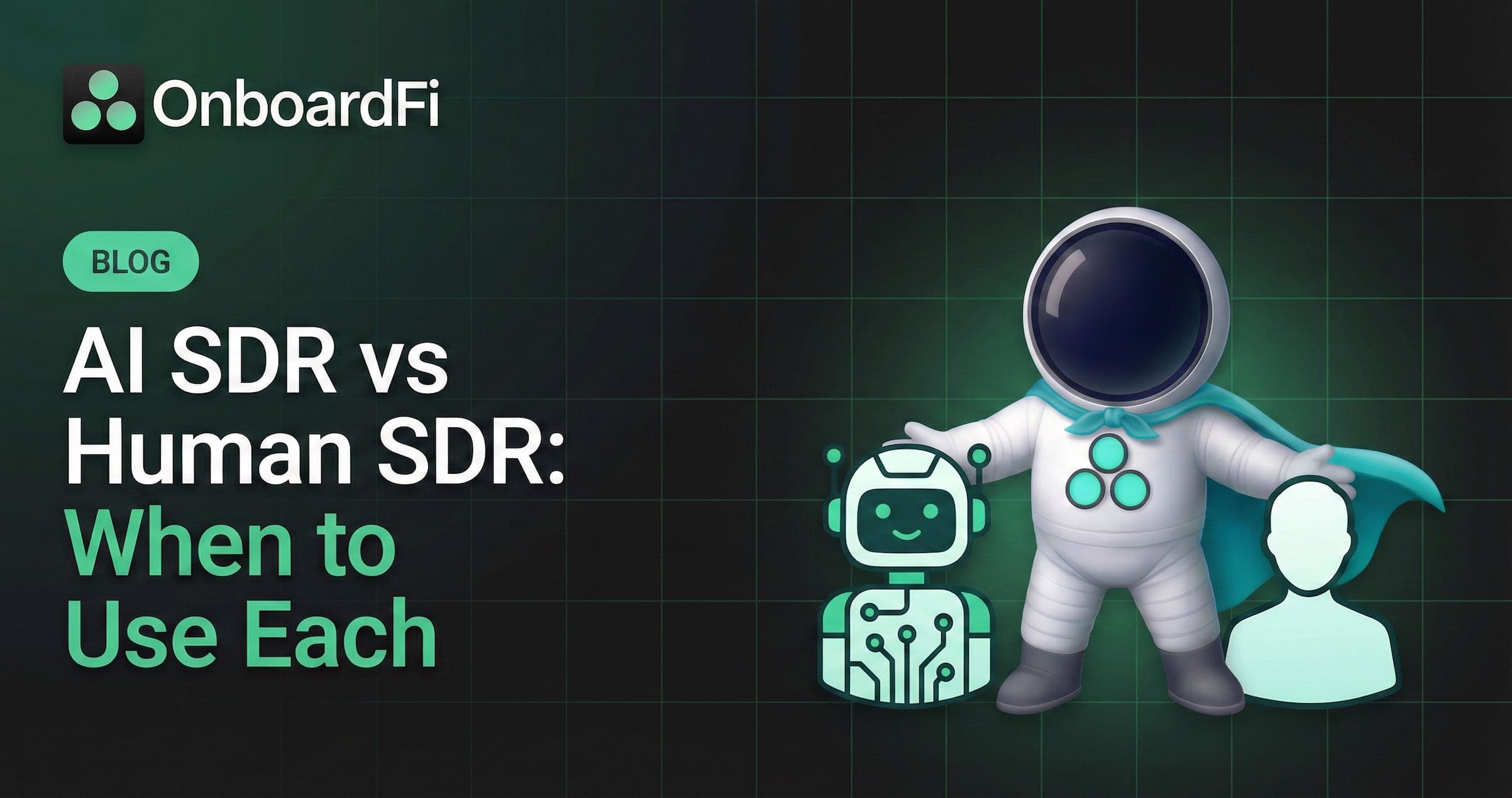
The AI SDR conversation has moved past "should we?" and landed firmly on "how much and how fast?" SaaStr predicts most SDRs will be AI SDRs by 2027, and adoption is accelerating in 2026. But the hype outpaces the nuance. AI SDRs save 83% on cost. They also convert meetings to opportunities at 40% lower rates than humans. Both numbers are real. Neither tells the full story.
This post breaks down when AI SDRs outperform humans, when they do not, and how to build a hybrid model that captures the best of both.
TL;DR
- AI SDRs cost $15,000-$35,000/year vs $75,000-$110,000/year for a fully loaded human SDR
- AI responds instantly, 24/7, and handles 1,000+ contacts per day — humans cap at 50-100
- Human SDRs convert meetings to opportunities at ~25% vs ~15% for AI — a real quality gap
- The winning model is hybrid: AI handles volume, speed, and qualification; humans close complex deals and build relationships
- Start with inbound response (where AI is strongest), then expand to outbound with oversight
What Is an AI SDR?
An AI SDR is software that automates top-of-funnel sales development — prospecting, qualification, outreach, and follow-up — using machine learning and natural language processing. Instead of a human rep reading through lead lists and sending emails, an AI agent identifies prospects, sends personalized messages, qualifies responses based on criteria you define, and routes warm leads to your closers.
The best AI SDRs go beyond email. OnboardFi's embedded AI SDR agent uses voice-first, video-native conversations to engage website visitors in real-time. No forms. No "someone will get back to you." A visitor lands on your site, and an AI agent with a video avatar starts a conversation immediately — qualifying the lead through natural dialogue, not a decision tree.
The market context matters: this is not speculative technology. AI SDR tools are shipping production-grade products, and the economics are compelling enough that ignoring them puts you at a structural cost disadvantage.
Head-to-Head Comparison: AI SDR vs Human SDR
Here is how the two stack up across the dimensions that matter.
| Dimension | AI SDR | Human SDR |
|---|---|---|
| Annual Cost | $15,000-$35,000 | $75,000-$110,000 (fully loaded) |
| Availability | 24/7, no downtime | ~8 hours/day, plus vacation and sick days |
| Response Time | Seconds | Minutes to hours |
| Daily Contact Volume | 1,000+ contacts | 50-100 contacts |
| Technical Questions Answered Immediately | 87% | 15% |
| Meeting-to-Opportunity Conversion | ~15% | ~25% |
| Payback Period | 3.2 months average | 8.7 months average |
| Ramp Time | Days | 3-6 months to full productivity |
| Emotional Intelligence | Limited | High |
| Complex Objection Handling | Struggles | Excels |
The 83% cost savings headline is real. So is the 40% quality gap on conversions. Context determines which number matters more for your business.
When AI SDRs Outperform Humans
Inbound Lead Response
Speed kills in inbound. Responding within 5 minutes dramatically increases qualification rates. An AI SDR responds in seconds — at 2 AM on a Sunday, across every time zone. No lead goes cold because your team was in a meeting.
For international businesses and high-volume inbound funnels, this is not an optimization. It is a structural advantage. A human team covering three time zones needs three shifts. An AI SDR just runs.
Initial Qualification and Routing
AI excels at structured qualification. It asks the right questions, scores responses against your ICP criteria, and routes qualified leads to the appropriate rep — instantly. This frees human SDRs from repetitive BANT-style qualification so they can spend their time on conversations that require judgment.
High-Volume Outreach
AI SDRs handle 1,000+ daily contacts with personalized messaging. Email response rates run 50% higher than human-sent templates because AI optimizes send times and personalization at scale. A human cannot write 1,000 genuinely personalized emails in a day. An AI can, and it gets better at it over time.
Data Enrichment and Research
AI scrapes, enriches, and synthesizes prospect data faster than any human researcher. It keeps CRM data clean and up-to-date automatically, eliminating the manual data entry that eats hours of an SDR's week.
When Human SDRs Are Irreplaceable
Complex, Multi-Stakeholder Deals
Enterprise sales with multiple decision-makers need human navigation. Mapping an org chart through conversation — understanding who has budget authority, who is the internal champion, who is the blocker — requires social intelligence that AI cannot replicate. An experienced rep reads the room. AI reads the transcript.
Objection Handling and Negotiation
AI handles FAQ-style objections well: "What does it cost?" "Does it integrate with Salesforce?" "How long is the contract?" But novel or emotional pushback — "We tried something similar and it failed" or "My CEO thinks AI is a fad" — requires empathy, creativity, and strategic reframing. This is where human SDRs earn their compensation.
Relationship Building
Trust is built through authentic human connection. Key accounts and strategic prospects deserve a human touch from the first interaction. The deal that closes because of a personal relationship is worth more than the deal that closes because of a fast response time.
For a deeper look at how the human role in sales is evolving, read about the changing role of human gatekeepers in sales.
Brand Representation at Events
Trade shows, conferences, and networking still require a human presence. AI can supplement with pre-event outreach and post-event follow-up, but the handshake at the booth is still a human job. The most effective event strategy uses AI to identify and pre-qualify attendees before the event, then lets your human reps spend their booth time on the highest-value conversations instead of scanning badges.
The Hybrid Model — How to Combine AI and Human SDRs
The best-performing sales teams in 2026 are not choosing between AI and human SDRs. They are dividing the work.
The Division of Labor
AI handles:
- Prospecting and lead list building
- Initial outreach and follow-up sequences
- Basic qualification against ICP criteria
- Meeting scheduling and calendar coordination
- Data entry and CRM hygiene
- After-hours and cross-timezone coverage
Humans handle:
- Discovery calls and deep qualification
- Complex objection handling
- Relationship building with strategic accounts
- Multi-stakeholder deal navigation
- Negotiation and custom proposals
- Event representation
The Handoff Protocol
The handoff between AI and human is where most hybrid models break down. Define clear criteria for escalation:
- Deal size threshold — Opportunities above a certain ACV get human attention from the start
- Question complexity — When the AI cannot answer confidently, it routes to a human
- Sentiment detection — Frustrated or skeptical prospects get human follow-up
The handoff should include context so the human does not start from zero. The prospect's questions, their qualification data, and their engagement history should transfer with the lead.
Implementation Roadmap
- Month 1: Deploy AI for inbound response and basic qualification. This is where AI delivers the fastest, most measurable results.
- Months 2-3: Expand to outbound prospecting with human oversight. AI drafts, humans review and approve.
- Months 4-6: Measure, optimize, and expand AI scope based on performance data. Let the numbers — not assumptions — guide how much you automate.
Expect positive ROI at 3-6 months with clean CRM data. If you are building processes from scratch, plan for 6-9 months.
Explore how an AI-led sales workflow fits into this hybrid model.
Implementation Guide — Getting Started with AI SDRs
Prerequisites
Do not skip these. AI SDR performance depends heavily on what you feed it:
- Clean CRM data — Garbage in, garbage out. Deduplicate, enrich, and validate before deploying AI.
- Defined ICP and qualification criteria — The AI needs to know what a good lead looks like. Be specific.
- Existing sales playbook — The AI trains against your process. If your process is not documented, document it first.
Common Pitfalls to Avoid
- Deploying for outbound before proving inbound. Start where AI is strongest — instant response to incoming interest — then expand. Inbound is where the data is cleanest and the intent is highest, making it the easiest environment for AI to prove value.
- Expecting set-and-forget results. AI SDRs still need training, prompt iteration, and regular review. Plan for ongoing optimization, especially in the first 90 days when you are learning what works for your specific market and ICP.
- Replacing all human SDRs at once. Augment first. Measure. Then decide how to reallocate headcount based on data. The goal in month one is learning, not cost-cutting.
- Ignoring data quality. AI SDRs are only as good as the data they work with. If your CRM is full of duplicates, outdated contacts, and missing fields, the AI will underperform — and you will blame the tool instead of the input.
How to Measure Success
Compare these metrics across AI and human channels:
- Cost per qualified meeting — AI should be dramatically lower
- Meeting-to-opportunity conversion rate — Humans will likely be higher; track the gap
- Customer sentiment and deal quality — Not just volume, but the quality of what comes through
- Time to first response — AI should win this every time
FAQ
What is an AI SDR and how does it work?
An AI SDR is software that automates sales development tasks using machine learning and natural language processing. It identifies prospects, sends personalized outreach, qualifies leads based on their responses, and schedules meetings — operating 24/7 without burnout.
Can AI SDRs replace human SDRs completely?
Not yet. AI SDRs convert meetings to opportunities at about 15% vs 25% for humans — a meaningful quality gap. The most successful teams use AI for high-volume, repetitive tasks and humans for complex qualification, relationship building, and strategic accounts.
How much does an AI SDR cost compared to a human SDR?
An enterprise AI SDR solution runs $15,000-$35,000 per year. A fully loaded human SDR (salary, benefits, tools, management overhead) costs $75,000-$110,000 per year. That is an 83% cost reduction, but factor in the conversion rate difference when calculating true ROI.
What tasks can AI SDRs handle vs. what requires a human?
AI excels at: instant lead response, basic qualification, high-volume outreach, data enrichment, and follow-up sequences. Humans are better at: complex objection handling, multi-stakeholder deal navigation, relationship building, and strategic negotiation.
Ready to add an AI SDR to your sales team? OnboardFi's Embedded Agent runs voice-first conversations with website visitors 24/7 — qualifying leads through natural dialogue, not forms. Book a demo to see it in action, or check pricing to get started.