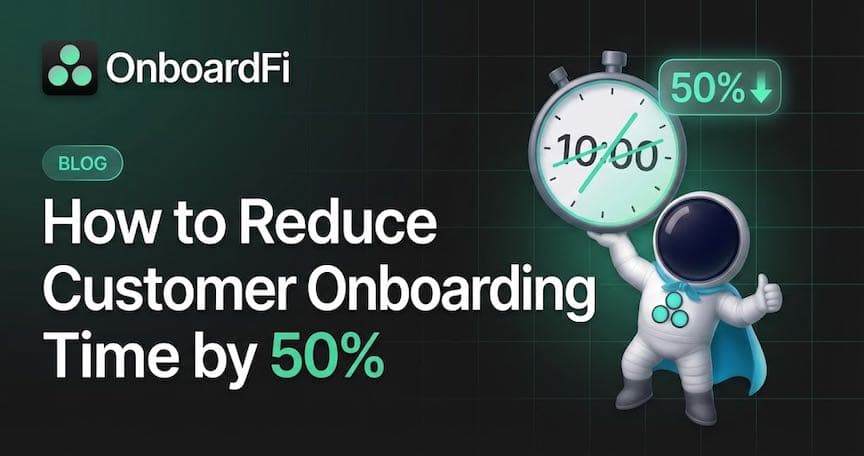
Every extra day in your onboarding process is a day your customer is not getting value. And in B2B, that clock starts ticking the moment the contract is signed. Customers expect to see ROI within 14 days. Go beyond that, and you are not just delaying value — you are compounding risk: slower time to value leads to lower NPS, higher churn, and more acquisition spend to replace the accounts you lost.
The good news: WebEngage cut their implementation time by 50% after standardizing their onboarding process. No additional headcount. No new hires. Just a better system. Here is how to reduce customer onboarding time by half using the same principles.
TL;DR
- The 5 biggest onboarding time-killers: manual document collection, fragmented handoffs, live training dependencies, unclear ownership, and client-side bottlenecks
- Each has a specific fix — document pre-fill (60% higher submission rates), shared workspaces, self-guided AI training, automated task assignment, and front-loaded requirements
- AI agents handle 75% of onboarding questions without human involvement
- Real-time progress tracking increases completion by 50%
- Use the self-assessment checklist at the end to identify your biggest win
The Hidden Cost of Slow Onboarding
Slow onboarding does not just frustrate customers. It creates a compounding problem across your entire business.
For your customers: Every day without value is a day they question the purchase decision. B2B buyers who do not see ROI within 14 days start looking at alternatives. By day 30, the internal champion who signed off on the deal is fielding questions from their boss about whether it was the right call.
For your team: Slow onboarding ties up CSM capacity. If each client takes 12 hours of CSM time over 30 days, your team is perpetually underwater. Other accounts get delayed. New deals close but sit in a queue. The bottleneck compounds.
For your revenue: Slow onboarding delays expansion revenue. A customer who takes 60 days to onboard is not buying add-ons at 90 days. They are still trying to figure out the basics. Multiply that across your customer base and the lost revenue is substantial.
For more on how AI is changing the customer success equation, read AI insights for customer success managers.
The 5 Biggest Onboarding Time-Killers
1. Manual Document Collection and Data Entry
Your team spends hours chasing contracts, credentials, configuration details, and compliance documents via email. Documents arrive in different formats. Data gets entered manually into multiple systems. One missing field holds up the entire process.
How much time it wastes: 3-7 days of elapsed time, mostly spent waiting for client responses to email requests.
The fix preview: Document pre-fill raises submission rates by 60%. Automate collection, validate instantly, and eliminate the email chase entirely.
2. Fragmented Handoffs Between Teams
Context gets lost every time a client moves from sales to onboarding to customer success. Each team asks the same questions. The client repeats themselves. Nobody has a complete picture of what was promised, what was configured, and what still needs to happen.
How much time it wastes: 2-5 days of rework and duplication, plus client frustration that erodes trust.
The fix preview: A shared workspace where sales context, onboarding tasks, and CS notes all live together. No handoffs because there is nothing to hand off.
3. Over-Reliance on Live Training Sessions
Scheduling live training across time zones adds days or weeks of delays. One late reschedule cascades through the entire onboarding timeline. And live training does not scale — you need a human available for every single session.
How much time it wastes: 5-10 days of scheduling delays, plus the CSM time spent on repetitive training that covers the same material every time.
The fix preview: Self-guided, on-demand training augmented with AI that answers questions in real-time.
4. Unclear Ownership and Accountability
When no one owns a specific step, it stalls silently. Tasks sit in limbo. The client does not know who to contact. Your team does not know what the client is responsible for. Nothing moves until someone asks "what's happening with this?"
How much time it wastes: 3-7 days of silent stalling, discovered only when someone checks.
The fix preview: Every task has an owner, a deadline, and an automated escalation path when it goes overdue.
5. Client-Side Bottlenecks (The Silent Killer)
This one is often overlooked because it feels outside your control. Clients lack internal resources, readiness, or executive sponsorship. Internal approval chains add hidden delays. Resistance to change slows adoption. And because these bottlenecks happen on the client's side, they are invisible until the timeline slips.
How much time it wastes: Highly variable — 1-3 weeks in some cases.
The fix preview: Identify required client-side stakeholders during the sales process, not after. Front-load the hardest requirements so delays happen early, not late.
Solutions for Each Time-Killer
Fix #1 — Automate Document Collection
Replace email-based document requests with structured intake:
- Pre-filled intake forms with data pulled from the sales process — 60% higher submission rates
- Secure document upload through a secure client portal for document management instead of email attachments
- Auto-validation that flags incomplete or incorrect submissions immediately, so clients fix issues on the spot instead of in a back-and-forth email thread
- Deadline reminders that trigger automatically when submissions are overdue
Fix #2 — Create a Single Onboarding Workspace
Eliminate handoffs by putting everyone in the same space:
- One shared portal where sales context, onboarding tasks, and CS notes all live together
- Client and internal team see the same status dashboard — no information asymmetry
- No data is lost between departments because there are no separate systems to transfer between
- Visit unified onboarding workspace to see how this works in practice
Fix #3 — Replace Live Training with Self-Guided + AI
Remove scheduling dependencies from your onboarding timeline:
- Interactive product demos that clients complete on their own schedule
- AI agents that answer questions instantly — 75% of onboarding questions resolved without a human. An AI demo agent for guided onboarding walks clients through your product via voice conversation, adapting to their pace and questions
- Predictive analytics that can reduce onboarding time by 30% by anticipating where users will struggle and proactively providing help
- Reserve live sessions for advanced topics and strategic discussions where human expertise adds genuine value
Fix #4 — Assign Every Task an Owner and a Deadline
Make invisible work visible:
- Automated task assignment with clear ownership for every onboarding step
- Real-time progress tracking that increases completion by 50% — when clients can see their progress, they are more motivated to finish
- Escalation triggers when tasks go overdue (e.g., auto-notify manager after 48 hours of no activity)
- Visual progress bars that keep both your team and the client aligned on what is done and what remains
Fix #5 — Front-Load Client-Side Requirements
Move the hardest work earlier in the process:
- Identify who in the client's organization is needed for each step during the sales process, not after close
- Move bottleneck steps earlier in the plan — do not save the hardest items for last when momentum has faded
- Provide step-by-step instructions with video walkthroughs for client-side tasks so they can complete work independently
- Set expectations on timeline and responsibilities in the kick-off call — before the onboarding clock starts
Building a 50%-Faster Onboarding Process (The Playbook)
Phase 1 — Audit Your Current Process (Week 1)
- Map every step with elapsed time and responsible party
- Identify which steps are client-dependent vs. team-dependent
- Find the 1-2 steps that take 80% of the total elapsed time — these are your targets
Phase 2 — Eliminate and Automate (Weeks 2-3)
- Remove steps that do not contribute to time-to-first-value (status meetings that could be dashboards, approval steps that could be automated)
- Automate document collection, scheduling, and status updates
- Deploy self-service training to replace scheduling-dependent live sessions
- Set up embedded AI agents to handle routine onboarding questions around the clock
Phase 3 — Standardize and Template (Week 4)
- Create onboarding templates for each customer segment
- Build personalized paths based on plan type, industry, or complexity — personalization increases completion by 35%
- Assemble a library of reusable assets: welcome email templates, training modules, FAQ documents, video walkthroughs
Phase 4 — Measure and Iterate (Ongoing)
- Track time-to-first-value for every cohort
- Compare automated cohorts vs. previous manual baselines
- Identify new bottlenecks as old ones are resolved — the constraint always moves
- Review monthly and optimize the slowest remaining step
Before and After — What 50% Faster Looks Like
| Metric | Before | After (Target) |
|---|---|---|
| Average onboarding time | 30 days | 15 days |
| CSM hours per client | 12 hours | 5 hours |
| Client tasks completed on time | 45% | 80% |
| Onboarding completion rate | 65% | 90% |
| Time to first value | 21 days | 10 days |
| Client effort score | 4.2/7 | 2.5/7 |
These numbers are directional benchmarks based on industry data. Your actual results depend on your starting point and product complexity. But the pattern is consistent: teams that fix even two of the five time-killers see 30-50% improvement.
Self-Assessment Checklist — Find Your Biggest Wins
Score each area from 1 (major problem) to 5 (fully optimized):
Document Collection
- How many emails does it take to collect all onboarding documents?
- Do clients submit documents through a portal or via email?
- Are submissions validated automatically or reviewed manually?
Handoffs
- Is there a single workspace where sales, onboarding, and CS collaborate?
- Do clients have to repeat information to different team members?
- Can a new team member pick up an account without asking the previous owner?
Training Delivery
- Can clients complete training on their own schedule?
- How many days of delay does scheduling add to your timeline?
- Do you have AI or self-service options for common questions?
Ownership and Accountability
- Does every onboarding task have a named owner and deadline?
- Can a client see their onboarding progress without asking someone?
- Are overdue tasks automatically escalated?
Client-Side Readiness
- Are required client stakeholders identified before onboarding starts?
- Are the hardest client-side tasks scheduled early in the process?
- Do clients have step-by-step instructions for their responsibilities?
Score interpretation:
- 20-25: Your process is strong. Focus on incremental optimization.
- 15-19: Solid foundation with clear improvement areas. Pick the lowest score and fix it first.
- Below 15: Your onboarding process is leaving weeks on the table. Start with the two lowest scores — that is where you will find the biggest gains.
FAQ
How long should customer onboarding take?
It depends on product complexity, but B2B customers expect to see ROI within 14 days. For most SaaS products, the target should be under 30 days for full onboarding, with first value delivered within the first week. If your onboarding takes 60+ days, you are likely losing clients before they see results.
What are the biggest causes of slow customer onboarding?
The top five: manual document collection, fragmented handoffs between internal teams, over-reliance on live training sessions, unclear task ownership, and client-side bottlenecks like approval delays and lack of executive sponsorship.
How can AI reduce onboarding time?
AI contributes in three main ways: instant answers to common questions (handling 75% of onboarding queries without a human), predictive analytics that identify at-risk accounts before they stall (reducing time by 30%), and self-guided product walkthroughs that eliminate scheduling dependencies.
What metrics should I track to measure onboarding speed?
Focus on time-to-first-value (when the client achieves their first meaningful outcome), onboarding completion rate, client effort score, and CSM hours per onboarded client. Track these per cohort so you can measure the impact of process changes over time.
Your onboarding is either accelerating growth or holding it back. OnboardFi combines AI agents, a client portal, and guided demos to eliminate the bottlenecks that keep onboarding slow. Book a demo to see how teams are cutting their onboarding time in half.