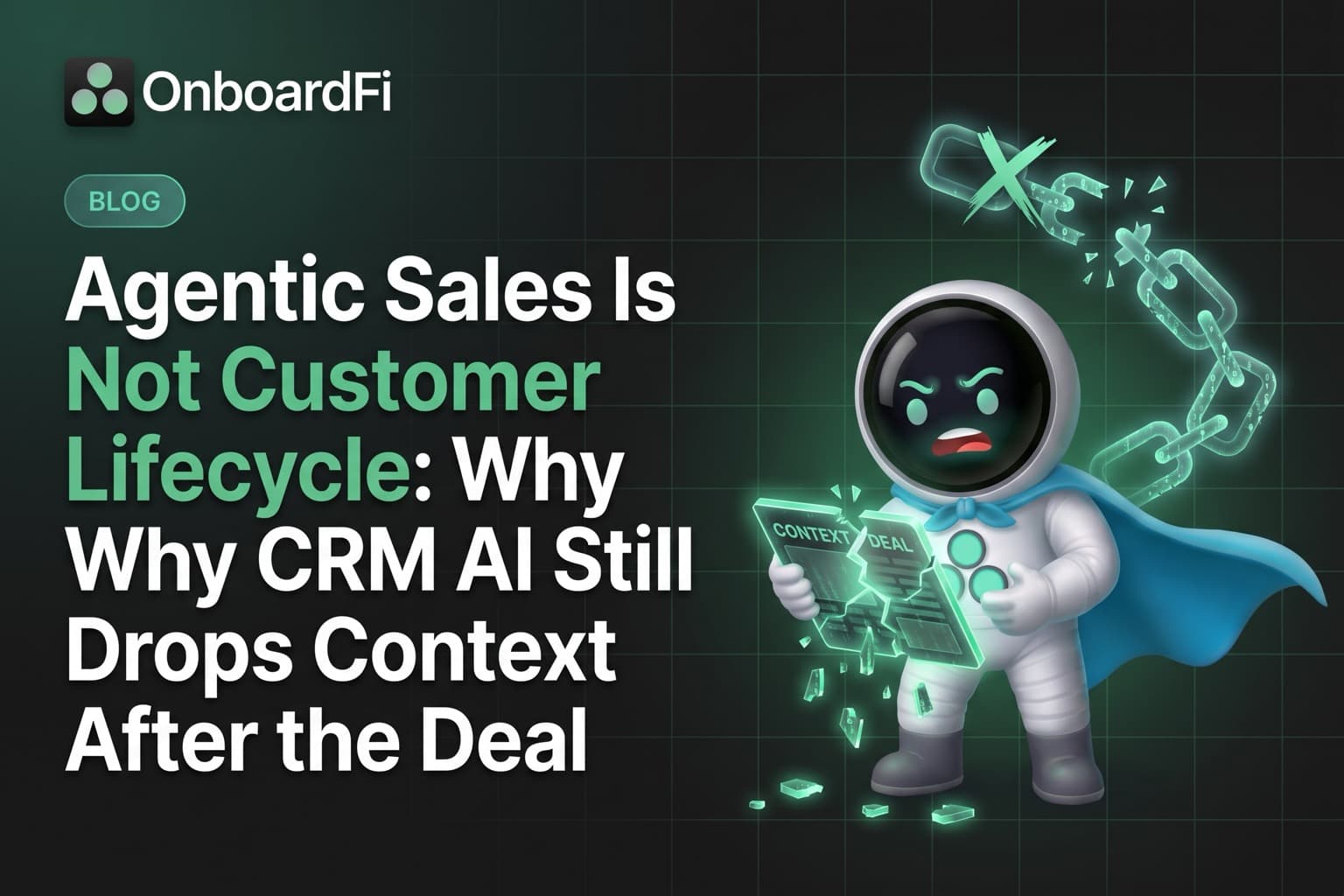
Agentic Sales Is Not Customer Lifecycle: Why CRM AI Still Drops Context After the Deal
The new AI sales narrative is simple: if your CRM can detect risk, suggest actions, and auto-generate follow-up, execution is handled.
The problem is that most "agentic sales" systems are still built around the deal record, not the customer journey.
That difference is exactly where revenue leaks.
Across the last few quarters, the market has seen a wave of launches promising AI-native revenue execution:
- Salesforce published how Agentforce lead-nurturing agents helped generate pipeline at scale (source: Salesforce Engineering).
- Outreach launched Omni, positioning AI agents as a new execution layer for revenue teams (source: Business Wire).
- Microsoft expanded Dynamics 365 AI agents across customer-facing workflows (source: Microsoft Dynamics 365 Blog).
This trend is real. The tooling is getting better.
But the core failure mode is still the same one we called out in The Sales Execution Gap: teams optimize for activity inside GTM tools, then lose continuity when a prospect becomes a customer.
The Category Is Optimizing the Wrong Transition
Most AI sales stacks optimize this transition:
lead -> opportunity
OnboardFi customers usually lose margin and retention in a different transition:
closed-won -> onboarding -> activation -> expansion
If you only optimize the first transition, you create a hidden debt: every "successful" deal now requires manual context stitching to become a successful customer outcome.
That is why teams keep reporting strong top-of-funnel AI lift while still experiencing:
- Week-one onboarding stalls
- Delayed project kickoff
- Repeated customer questions already answered during sales
- CSMs rebuilding context from scattered notes and call snippets
We broke down this exact drop-off pattern in The Demo-to-Onboarding Drop-Off. The data pattern has not changed. AI made sales throughput faster, but handoff quality stayed brittle.
Why CRM-Centered AI Loses Context
CRM AI is useful. It is just pointed at the wrong center of gravity.
Most implementations enrich and automate around:
- Field completion
- Opportunity scoring
- Sequence recommendations
- Forecast hygiene
What they usually do not preserve with high fidelity is conversational intent across lifecycle stages.
A buyer does not think in objects and statuses. They think in constraints:
- "Our team cannot wait three weeks for implementation."
- "Security review is our blocker."
- "We need this live before renewal planning."
If that context is captured during qualification but not operationalized during onboarding, the system did not execute. It logged activity.
This is the same reason static tours underperform for high-intent buyers: they capture clicks, not narrative urgency. We covered this in The Self-Serve Demo Trap.
Agentic Sales Without Lifecycle Orchestration Creates a New Ops Burden
The paradox of "AI that executes" is that partial execution can increase manual work downstream.
Here is what happens in practice:
- AI SDR layer drives more qualified conversations.
- Pipeline velocity increases.
- Onboarding and CS teams inherit higher volume with fragmented context.
- Humans create ad hoc workflows to compensate.
- Time-to-value degrades, even while sales dashboards look healthy.
This is why many teams now describe a follow-through bottleneck, not a lead bottleneck.
The right question is no longer "Did AI book the meeting?"
The right question is: Did the customer progress through the next lifecycle stage with less friction than before?
The Shift: From Agentic Sales to Agentic Lifecycle
If you want durable lift, your architecture has to move from channel agents to lifecycle agents.
That means:
- The same conversational thread that qualifies a buyer should inform onboarding kickoff.
- Project and portal workflows should inherit sales context automatically.
- Execution should continue after the deal, not reset at each team boundary.
- Customer health and risk should come from live interactions, not lagging snapshots.
In other words, the system has to operate as a lifecycle layer, not a sales plugin.
That is exactly the design principle behind OnboardFi:
- An embedded AI agent captures intent before form friction.
- The customer portal carries that context into onboarding and delivery.
- Lifecycle execution is maintained through one operating surface instead of disconnected handoffs.
What to Audit This Quarter
If your team already invested in agentic sales tooling, run this audit now:
- Pick 20 recent closed-won deals.
- Measure how many required manual context transfer from sales to onboarding.
- Measure first-value milestone time vs. your target.
- Compare customer questions in week one vs. what was already discussed pre-sale.
If this gap is large, your AI stack is still front-loaded. You improved pipeline math, but not lifecycle economics.
The Practical Position for 2026
AI SDR and CRM copilots are table stakes now. Ignore them and you lose speed.
But speed alone is not a moat.
The moat is preserving conversational context from first touch through expansion, then turning that context into consistent execution across teams.
That is the difference between:
- AI that produces more activity
- AI that produces better customer outcomes
And in 2026, the second category is where retention and margin are won.
If you want to close the lifecycle execution gap, start by deploying an agent where buyer intent is created, then keep that thread alive through onboarding and success.
See how OnboardFi's lifecycle architecture works in production: /embedded-agent.