Most teams think onboarding starts at kickoff.
It does not.
Onboarding starts the moment a prospect says yes.
The fastest way to lose momentum is the gap between demo and day-one execution. Sales has context. Customer success has a task list. The customer has urgency. Then the handoff happens and everything slows down.
By the time kickoff lands, the account has already cooled.
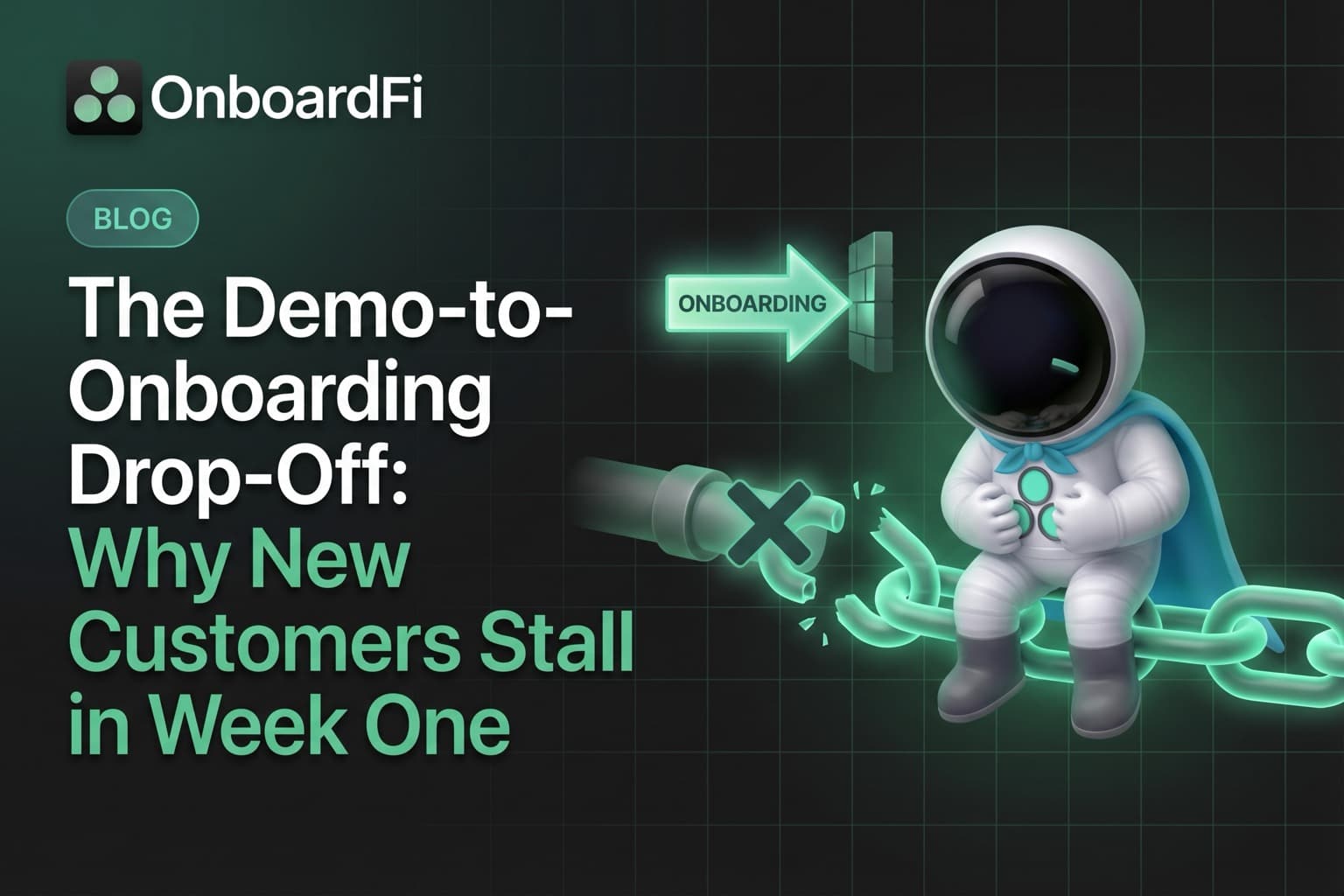
This is the demo-to-onboarding drop-off. It is where new revenue quietly turns into delayed value, delayed expansion, and preventable churn.
The Real Failure Is Not “Bad Onboarding.” It Is Broken Handoff Logic.
Most onboarding programs are designed as if information naturally moves between teams. It does not.
Sales notes are partial. Calls are not synthesized into action plans. Internal systems store data but do not preserve buying intent in usable form. The customer repeats the same context to a new team, then waits.
That waiting period is expensive.
If your first week depends on manual follow-up, ad hoc summaries, and disconnected tools, your onboarding timeline is already at risk.
This pattern is now visible across categories:
- Rocketlane's 2026 handoff guide calls out sales-to-CS transition quality as a primary onboarding risk factor: Sales to Customer Success Handoff: A Complete Guide (2026)
- Appian documented a real-world onboarding compression from six months to four days once process execution was automated: How Acclaim Autism cut patient onboarding from six months to four days with Appian
- PYMNTS highlights the direct link between onboarding quality and time-to-value outcomes in B2B systems: Smarter B2B Onboarding With Digital IDs Drives Time-to-Value
The point is not that you need one more checklist.
The point is that week-one outcomes now depend on execution systems, not documentation systems.
Why Week One Breaks
In most orgs, week one fails for five predictable reasons.
1. Discovery context is trapped in sales artifacts
Demo calls capture pain points, political risk, budget constraints, internal blockers, and urgency signals. But that context is rarely transformed into a live onboarding brief that teams can execute against.
2. Ownership is ambiguous for the first 72 hours
Everyone assumes someone else is driving kickoff prep. No one owns the customer-facing plan from signature to kickoff.
3. The customer gets a project shell, not guided momentum
A portal with empty tasks is not onboarding. Customers need guided next actions, clear sequencing, and rapid answers tied to their specific implementation path.
4. Internal activity is not visible to the customer
When work happens in siloed tools, customers interpret silence as inactivity. Confidence drops even if your team is actually moving.
5. Risk signals are observed too late
By the time someone labels the account “stalled,” momentum has already been lost for days.
These are execution failures, not communication failures.
What High-Performing Teams Do Differently
Teams that reduce onboarding drag do three things consistently:
- They convert sales conversations into structured onboarding actions immediately.
- They expose progress to customers in real time.
- They deploy automation at the exact moments where humans tend to delay follow-up.
That model aligns with the same pattern we outlined in The Sales Execution Gap: context without action is not an asset.
It also aligns with the revenue-side operating problem in Quota Chaos in 2026: teams collect more signals than they operationalize.
If week one feels chaotic, the issue is rarely effort. The issue is conversion of context into coordinated action.
The Conversational Fix: Replace Static Handoffs With Active Guidance
OnboardFi's approach is straightforward:
- Capture the real buying and implementation context through conversation.
- Convert that context into customer-specific onboarding actions.
- Execute follow-up and status progression automatically across the first week.
This is why the combination of the Embedded Agent and Customer Portal matters.
- The Embedded Agent captures intent, constraints, and stakeholder language before and during the buying process.
- The Customer Portal turns that context into visible phases, tasks, and guidance that both teams can act on.
Instead of forcing the customer to restate priorities at kickoff, you start from what they already told you.
Instead of emailing static onboarding docs, you run guided conversations that move the implementation forward.
Instead of waiting for a CSM to manually detect risk, you detect slippage as soon as expected actions are missed.
A Practical Week-One Operating Model
If you want to eliminate demo-to-onboarding drop-off, run week one like this:
Day 0: Close + context freeze
- Generate a structured handoff brief from sales conversations.
- Lock success criteria, stakeholders, timeline constraints, and blockers.
- Publish customer-visible onboarding path immediately.
Day 1: Guided kickoff prep
- Launch a customer-facing checklist with explicit owners and due windows.
- Trigger conversational follow-ups for missing prerequisites.
- Surface unresolved dependencies before kickoff, not during kickoff.
Day 2-3: Execution with continuous visibility
- Advance phase status based on completed actions, not status meetings.
- Provide customer-facing progress updates in portal context.
- Escalate risk automatically when no movement occurs within defined windows.
Day 4-5: Early value proof
- Validate the first measurable outcome tied to the original buying case.
- Confirm stakeholder alignment and next milestone owners.
- Attach expansion signals to execution behavior, not subjective sentiment.
This is exactly where most teams underperform: they run onboarding as a calendar event, not a workflow.
The KPI Shift You Need
If your onboarding dashboard is mostly activity metrics, you are measuring effort, not progression.
Track these instead:
- Time from signed deal to first customer action in portal
- Time from signed deal to first delivered value milestone
- Percentage of onboarding accounts with complete handoff brief in first 24 hours
- Percentage of accounts with no unresolved blocker older than 48 hours
- Week-one engagement rate by stakeholder role
These metrics expose whether your process actually converts sales momentum into delivered value.
Why This Matters Beyond Onboarding
The first week sets the tone for the entire lifecycle.
If week one is fragmented, renewals become defensive.
If week one is coordinated, expansion becomes easier because trust compounds early.
That is why onboarding quality is not a CS-only concern. It is a revenue system concern.
Organizations that treat onboarding as a post-sale admin workflow will keep leaking value between functions. Organizations that treat onboarding as a continuation of the buying conversation will compress time-to-value and improve retention economics.
Final Take
The biggest onboarding risk in 2026 is not tool shortage.
It is handoff decay.
Every day between demo and active onboarding is a chance for customer urgency to fade. If you want better retention, stop asking whether your team has enough playbooks and start asking whether your context becomes action fast enough.
If you want to operationalize this model, start with a conversational execution layer that carries context from first touch through delivery. OnboardFi gives you that path with an embedded conversational front door, customer-facing workflow execution, and lifecycle intelligence that flags risk before momentum is lost.
Build your week-one engine now. Then scale it.
Explore how to deploy it in your own onboarding motion: Use Cases: Onboarding or launch an implementation-ready flow with OnboardFi Embedded Agent.