AI SDR launches are everywhere.
In one week, the market saw new agentic sales announcements from TruGen Clara AI SDR, Outreach Omni, and Microsoft’s new agentic sales/CX positioning.
The narrative is clear: every revenue platform now promises autonomous pipeline execution.
Most teams hear this and conclude they need one more bot.
Wrong diagnosis.
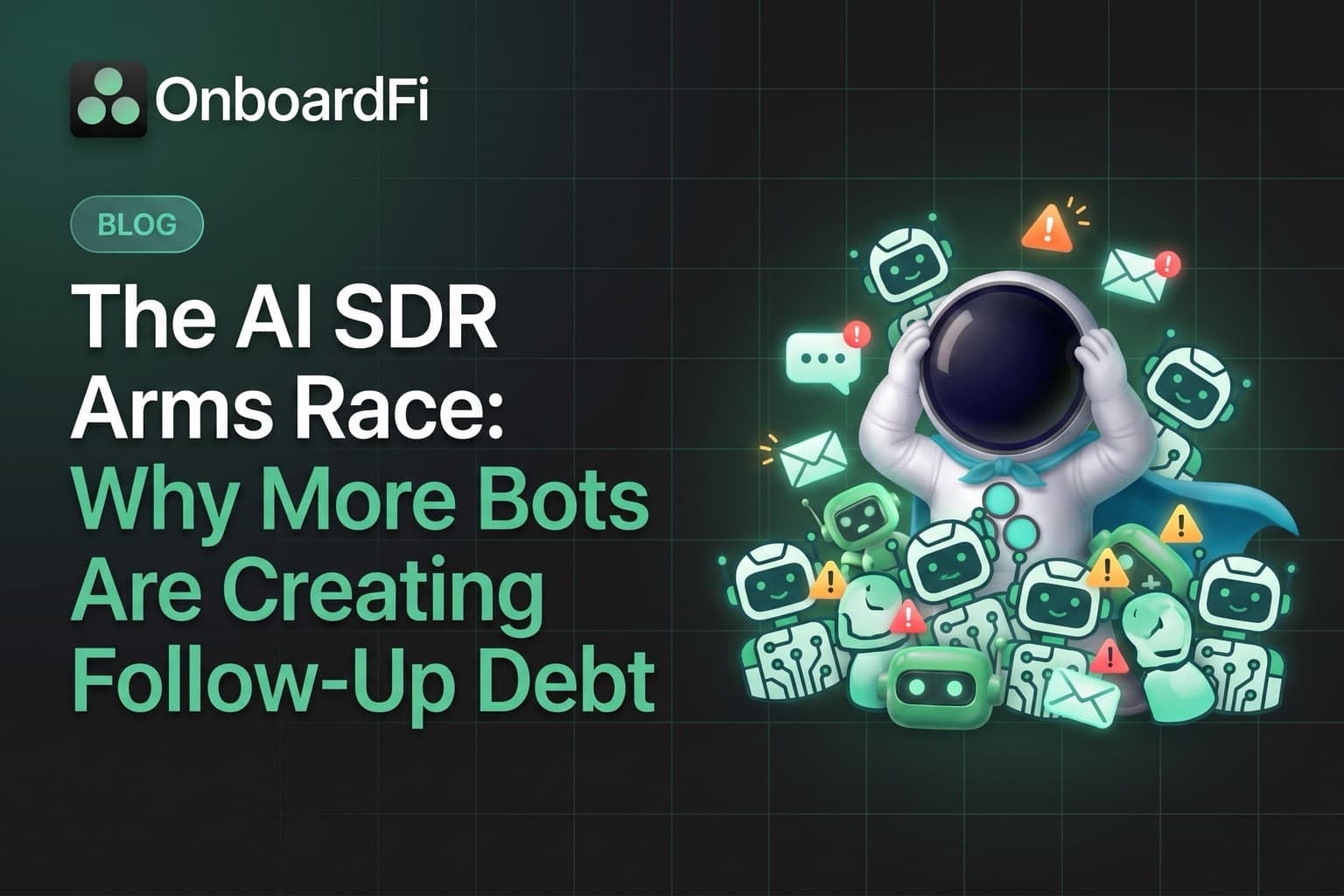
The biggest problem is not conversation volume. It is execution reliability after the conversation.
That is where follow-up debt starts.
What Follow-Up Debt Actually Is
Follow-up debt is the backlog of high-intent buyer signals your team captures but does not operationalize in time.
It compounds when:
- Your AI SDR has a strong conversation, but no one owns the next action window
- CRM records update, but no workflow triggers the right human or agent task
- Qualification summaries exist, but onboarding still starts from scratch
- Objections are detected, but they are not routed to the right closer with context
The team feels busy. Dashboards look active. Pipeline appears healthy.
Then deals stall in handoff.
This is the same structural failure outlined in The Sales Execution Gap: signal capture improves faster than execution discipline.
Why the AI SDR Arms Race Increases the Risk
More AI SDR tooling creates more conversational surface area. That can be a strength, but only if your operating model converts conversations into action.
Without that layer, the arms race creates four predictable failures.
1. Qualification quality becomes inconsistent across channels
One bot handles website chat. Another handles outbound follow-up. A third handles demo routing. Each collects different fields, confidence scores, and objection language.
Your revenue team gets fragmented context instead of one execution-ready brief.
2. The "AI did it" assumption hides ownership gaps
As soon as an SDR agent is live, teams assume follow-up is handled.
In practice, many workflows still depend on manual triage: reading transcript summaries, assigning owners, and crafting responses.
If the owner is unclear, speed collapses.
3. CRM updates are mistaken for pipeline movement
Auto-updated fields are useful. They are not execution.
A contact status change is not the same as a scheduled next step, stakeholder alignment, or an onboarding kickoff with preserved intent.
4. Customer lifecycle continuity breaks after the demo
The conversation data that closed the meeting rarely survives into onboarding, implementation, and retention workflows.
So every phase re-asks the same questions.
Buyers feel that as friction.
The Market Signal Most Teams Are Missing
Current GTM research signals point to a category shift from analytics to action:
- MiaRec’s AI Action Engine launch frames the core challenge as turning conversation insight into reliable follow-up execution.
- TruGen’s Clara launch emphasizes always-on qualification and booking from inbound traffic.
- Outreach Omni doubles down on AI-assisted revenue execution.
The pattern is not "AI chat got better."
The pattern is "every vendor is racing toward workflow ownership."
If your stack still treats conversation as a data artifact instead of an execution trigger, you will lose speed even with better AI agents.
A Better Operating Model: Conversation-to-Execution Continuity
High-performing teams do not ask, "Which AI SDR should we buy?"
They ask, "How do we guarantee every high-intent conversation becomes a concrete next step within the same day?"
That requires continuity across three layers.
Layer 1: Capture decision-grade context
Use conversational qualification to collect what forms and static demos cannot:
- Why now
- Buying committee shape
- Implementation constraints
- Objections that can kill momentum
This is where Embedded Agent flows outperform static top-of-funnel capture.
Layer 2: Translate context into workflow ownership
Every critical signal needs a deterministic action path.
Examples:
- Pricing objection from target account -> assign AE + generate rebuttal brief
- Security concern -> route to technical owner + attach trust docs
- Implementation risk -> create onboarding task before contract signature
No generic "follow up later" states.
Layer 3: Preserve context through onboarding and retention
When the deal moves forward, context must carry into delivery.
If customer teams cannot see the same intent narrative sales captured, time-to-value slows and churn risk rises.
That is why lifecycle visibility in a shared Customer Portal matters more than another isolated sales automation surface.
The 30-Day Follow-Up Debt Audit
If you already have AI SDR workflows live, run this audit.
Step 1: Sample 25 recent high-intent conversations
Use sessions where the buyer asked about pricing, integration, or implementation timeline.
Step 2: Check time-to-first-action
For each session, measure how long it took to trigger a concrete next step owned by a person or an agent.
Target: same business day.
Step 3: Check context preservation
Can onboarding or success teams access the buyer’s exact goals, blockers, and commitments without asking sales for Slack context?
Step 4: Quantify follow-up debt
Track:
- Percent of high-intent sessions with no next-step action in 24 hours
- Percent of opportunities where onboarding restarts discovery
- Percent of stalled deals with known but unresolved objections in transcript logs
Step 5: Fix one workflow path first
Do not boil the ocean.
Start with one repeatable failure mode, usually demo-request handoff.
This is the practical progression from The Self-Serve Demo Trap: once you capture intent, you must operationalize it.
Where OnboardFi Fits
OnboardFi is not another chatbot layer.
It is the conversation-to-execution system for revenue and lifecycle teams.
The model is straightforward:
- Capture conversational intent at the moment buyers engage.
- Convert that intent into structured tasks, owner assignments, and workflow triggers.
- Keep that context alive through onboarding and customer success.
That is how teams reduce follow-up debt while competitors are still optimizing transcript summaries.
The Strategic Bet for 2026
The AI SDR category will keep expanding. More launches. More claims. More "autonomous" branding.
The durable advantage will not come from who starts the most conversations.
It will come from who closes the most context-to-action loops without human lag.
If your current motion still depends on manual interpretation after every conversation, you do not have autonomous revenue execution.
You have automated lead capture with delayed follow-up.
That delay is follow-up debt. And it compounds fast.
If you want to run a cleaner model, start with OnboardFi Embedded Agent, connect it to your Use Cases: Sales workflows, and make every high-intent conversation operational within the same day.