Revenue teams did what the market told them to do.
They bought AI.
They instrumented calls, added enrichment, automated routing, and layered copilots into CRM workflows. On paper, this should have made quotas easier to hit.
But market signals are showing the opposite pattern: high AI adoption, persistent quota instability, and execution breakdowns in the minutes and hours after buyer intent appears.
That is the 2026 revenue paradox.
Not a data shortage. Not a dashboard shortage. An execution architecture problem.
The Market Signal Is Clear: AI Adoption Is Up, Quota Reliability Is Not
Multiple independent signals in the last month point in the same direction:
- CaptivateIQ's sales survey coverage reports quota chaos despite rising AI use (IT Brief US).
- Vendasta’s CRM AI launch frames the same root issue: teams capture conversations, but follow-through still breaks; their launch callout says 90% record meetings while 74% fail to act consistently (GlobeNewswire).
- Apollo is pushing hard on end-to-end agentic GTM, citing nearly 20,000 weekly users and stronger early meeting-booking outcomes (PR Newswire).
- Field operators are publishing the same tactical diagnosis: intent data only works when follow-up latency is measured in hours, not days (MarketBetter).
Different categories. Same pattern.
Teams are improving data capture faster than they are improving time-to-action.
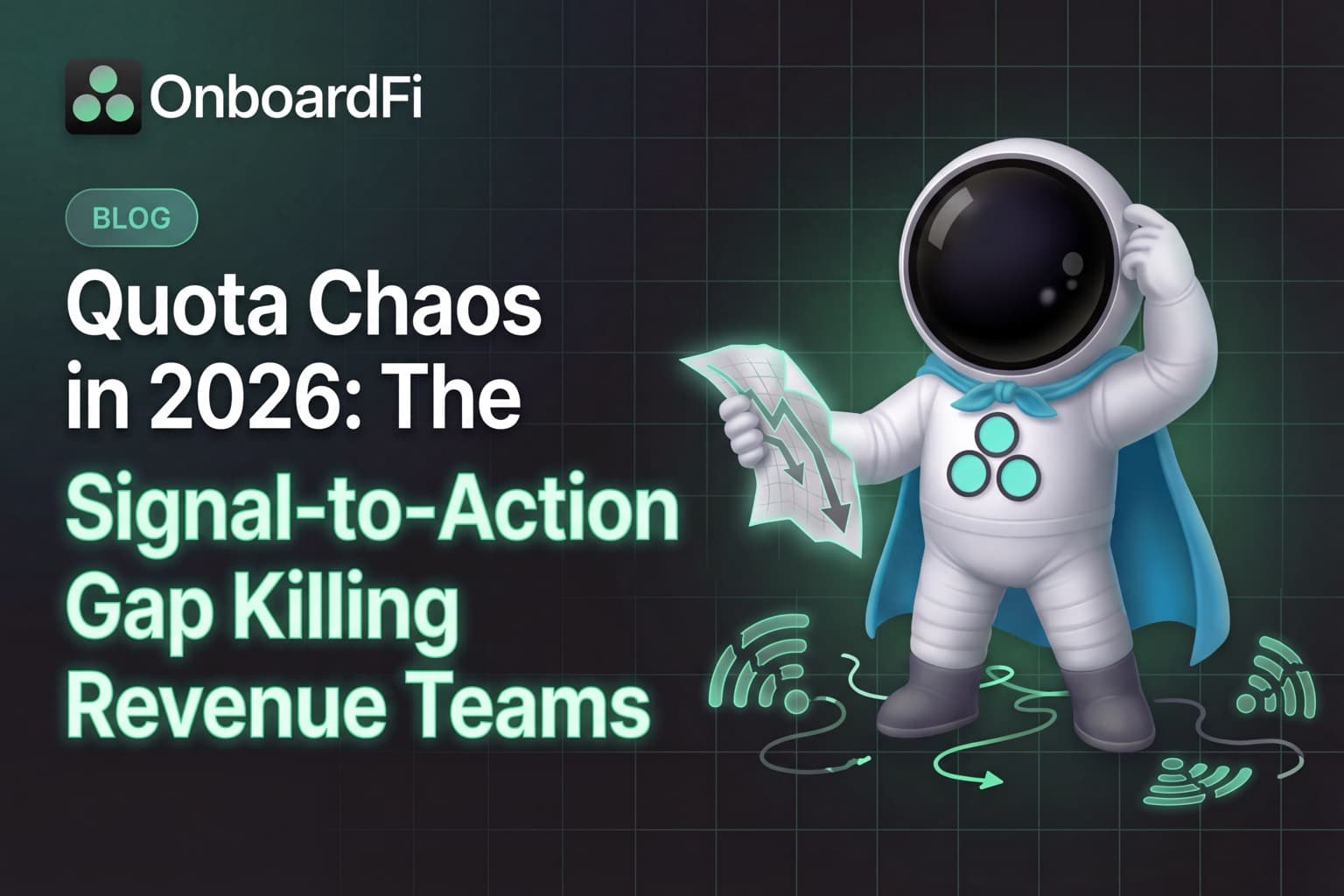
Quota Chaos Starts in the Gap Between Signal and Execution
Most GTM stacks now do the first half of the job well:
- Detect intent.
- Summarize context.
- Update records.
Then the system hands work back to a human queue.
That handoff is where pipeline quality degrades.
If intent appears at 10:07 AM and meaningful response happens at 4:40 PM, your stack did not execute. It documented.
This is why the same organization can have "great CRM hygiene" and still miss quarter-end numbers. Hygiene is table stakes. Revenue requires speed plus context continuity.
The Missing Operating Layer: A Signal-to-Action SLA
Most teams run formal SLAs for support tickets. Almost none run formal SLAs for commercial intent response.
That is a mistake.
If you want predictable pipeline outcomes, define a Signal-to-Action SLA for revenue operations:
- Hot inbound intent: first meaningful response in <15 minutes
- Event/webinar attendees with explicit interest: qualification touch in <2 hours
- Post-call next step confirmation: sent same business hour
- No-owner signal events: owner assigned + action initiated in <10 minutes
Without these constraints, automation becomes cosmetic. The system can look advanced while response behavior remains random.
Why AI Copilots Alone Do Not Fix It
Copilots are useful. They are not sufficient.
A copilot can draft the perfect follow-up. It cannot guarantee the follow-up happens in time unless it owns execution.
This is exactly where many teams get stuck:
- Better notes, same delays
- Better summaries, same handoff friction
- More intent alerts, same rep bandwidth bottlenecks
If your workflow still depends on someone noticing a notification and manually prioritizing it, you are still operating on human queue latency.
That is the same failure mode behind the sales execution gap, just with more AI infrastructure around it.
The Context Decay Problem Nobody Budgets For
Latency does more than lower reply rates. It causes context decay.
When follow-up is delayed, reps default to generic outreach because the conversational thread is no longer active in memory. That creates three compounding costs:
- Lower conversion because outreach feels disconnected
- Longer cycles because discovery is repeated
- Higher CAC because expensive rep time is spent reconstructing context already captured once
This is why conversational enrichment beats raw demographic enrichment in live sales motion. A title, company size, and funding round do not tell you what the buyer actually needs to decide now.
The conversational layer does.
What High-Performing Teams Do Differently
Top-performing teams treat signal handling like production operations, not inbox management.
They build a closed loop:
- Detect: capture signal events with buyer-level context
- Decide: classify urgency + likely buying stage automatically
- Execute: trigger a context-aware first action immediately
- Verify: log whether action happened inside SLA window
- Escalate: route only exceptions to humans
Notice what is missing: "wait for someone to get to it later."
That model also aligns with modern inbound sales architecture described in AI SDR vs Human SDR: humans do highest-leverage judgment; agents handle time-critical continuity work.
Where Quota Chaos Usually Hides
If your team is missing forecast despite strong activity volume, audit these four areas first:
1. Alert Volume Without Action Ownership
Signals fire, but no deterministic owner/action chain exists.
2. CRM Updates Without Workflow Guarantees
Records get enriched, but no mechanism guarantees next-step execution in bounded time.
3. Great Discovery, Weak Handoff Continuity
The first conversation captures high-value context; the second conversation starts cold.
4. Manager Visibility Without Intervention Controls
Leaders can see lag in dashboards, but cannot enforce SLA behavior in real time.
These are operational design failures, not effort failures.
Practical Rollout: 30 Days to Reduce Signal-to-Action Latency
You do not need a full platform migration to start.
Week 1: Baseline the Real Numbers
Measure current median and p90 latency from detected signal to meaningful first action.
Week 2: Define SLA Tiers by Signal Type
Separate high-intent inbound, event follow-up, and post-call next-step confirmation.
Week 3: Automate First-Mile Execution
Move first response + qualification trigger to an agentic workflow layer.
Week 4: Add Exception Escalation
Route only out-of-SLA or high-complexity cases to human reps with full context bundle.
Track one outcome metric ruthlessly: signal-to-qualified-conversation time.
If that metric drops, quota consistency improves before most teams expect it.
Why This Matters Beyond Pipeline Creation
This is not just a top-of-funnel issue.
Teams that cannot execute quickly in sales usually cannot execute quickly in onboarding or success either. The same latency pattern that hurts pipeline also hurts activation and expansion.
That is why lifecycle systems matter. Once a buyer converts, the execution layer should continue across onboarding and customer operations through the same context model, not reset to zero in a new tool. The same applies across product surfaces, whether teams deploy a dedicated Guide Agent or coordinate customer phases inside a Customer Portal.
The Strategic Takeaway
2026 GTM winners will not be the teams with the most AI features.
They will be the teams that enforce the fastest, most context-aware signal-to-action loop.
If your stack is excellent at recording what happened but inconsistent at doing what should happen next, quota chaos is not a mystery. It is the expected outcome.
OnboardFi is built to close that gap with conversational agents that capture intent in real time and execute first-mile follow-through before momentum cools.
If you want to reduce response latency without adding headcount, start with the execution layer.
See how the OnboardFi Embedded Agent turns live intent into immediate, context-aware action.