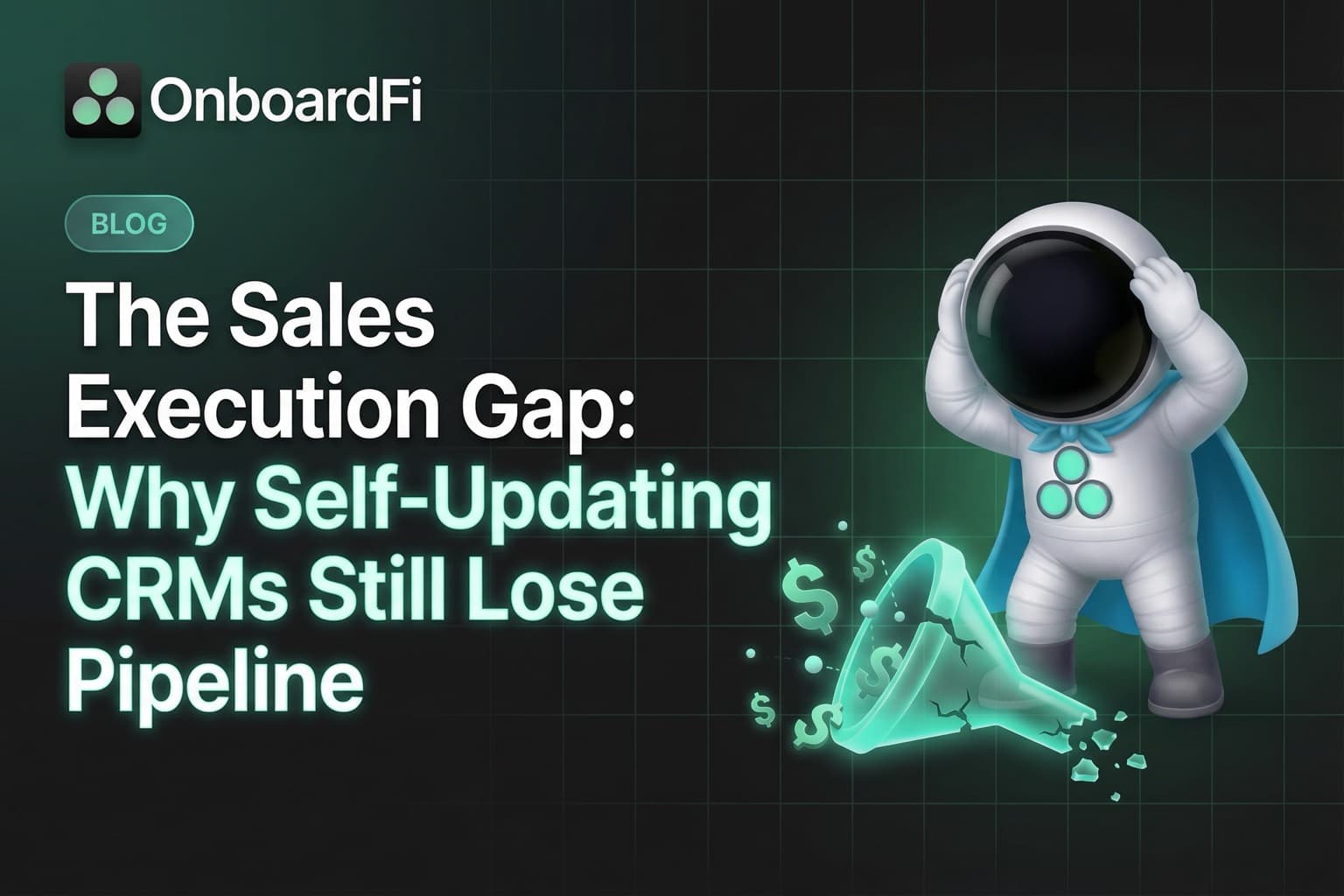
Your CRM is not failing because fields are empty.
It is failing because actions are late.
Most teams already did the obvious work. They connected meeting recorders. They turned on AI notes. They bought enrichment tools. They can now see more data than ever. But seeing more data is not the same as moving deals faster.
That gap between insight and execution is where pipeline leaks.
You can call it the sales execution gap: the time and friction between "we detected a buying signal" and "the right follow-up actually happened."
The Market Already Admitted the Problem
This is no longer a niche complaint from RevOps teams. The broader market is now publishing the same pattern in different language:
- Vendasta’s CRM AI launch centers on the claim that teams record meetings but still fail to turn conversations into consistent action (Markets Insider).
- Zapier’s analysis of 10,000 AI workflows says lead management is now the top AI automation use case (Business Wire).
- SignalHire is pushing the timing argument hard: identify intent early, act same-day, convert more (The Herald News).
- SalesIntel and other outbound vendors are repositioning around turning "signals into outreach automatically" (PRWeb).
Different vendors, same diagnosis: data capture is improving faster than operational follow-through.
Why "Self-Updating CRM" Is Necessary but Insufficient
A self-updating CRM does solve real problems. It reduces manual entry. It preserves context. It gives managers better visibility.
But it does not automatically solve the highest-leverage question in B2B sales:
Did we execute the right next step fast enough while buyer intent was still hot?
A record update is state. Revenue comes from motion.
When teams confuse those two, they overestimate their maturity.
A common pattern looks like this:
- Buyer signal appears (site visit, call intent, webinar attendance).
- AI summarizes and enriches the record.
- Team celebrates "better data hygiene."
- Follow-up still depends on a human queue.
- Queue delays follow-up by 24 to 72 hours.
- Buyer momentum cools.
Everything in that flow can look healthy in dashboards while conversion actually drops.
The Real Unit of GTM Performance Is Response Latency
Most GTM teams still optimize for output metrics: calls logged, touches sent, fields completed.
The stronger operating metric is latency:
- Signal-to-first-response latency
- Signal-to-qualified-conversation latency
- Signal-to-next-committed-step latency
If those intervals are long, your "AI-enhanced" stack is decorative.
This is especially true for inbound and event-driven demand. Inbound intent decays fast. Webinar follow-up decays even faster. By the time a rep opens the activity list, the prospect has already moved to another narrative.
That is why the strongest modern content in this category is shifting from "AI helps reps" to "AI executes the first mile reliably."
The Hidden Cost: Pipeline Context Rot
There is another failure mode that is harder to spot than delayed outreach: context rot.
Every hour between signal and action increases the probability that the next touch is generic. Generic follow-up creates two expensive outcomes:
- Lower reply quality (prospect feels misunderstood)
- Longer cycle time (you must re-collect context that already existed)
This is the same core issue we discussed in Voice AI vs Chatbots for Lead Qualification: raw interaction volume is less important than the quality and continuity of context captured in the first conversation.
Teams that win do not just route leads faster. They preserve intent fidelity across every handoff.
Where Most Revenue Teams Still Break
Across tooling categories, execution breaks in four predictable places.
1. Detection Without Ownership
Signals are collected, but no explicit actor owns immediate execution. The system "alerts" a person and hopes capacity exists.
2. Summaries Without Commitments
AI produces recap text but does not enforce next-step commitments, deadlines, or owner confirmation.
3. Enrichment Without Workflow Routing
Records are enriched, but nothing auto-routes the right playbook by buying stage, use case, or objection pattern.
4. Visibility Without Intervention
Leaders can see lag in dashboards, but intervention is delayed because no autonomous layer closes the loop in real time.
This is exactly why sales and onboarding motions often stall in parallel. The same operating weakness that slows first response also slows implementation follow-through, as we covered in Reduce Customer Onboarding Time by 50%.
What High-Performance Execution Looks Like
If you want to close the execution gap, optimize for this sequence:
- Capture the signal in context, not as a naked event.
- Classify urgency and intent stage automatically.
- Trigger an immediate, context-aware response through an AI agent.
- Collect objection and use-case detail conversationally.
- Sync structured outcomes to CRM and pipeline systems.
- Escalate to human reps only where judgment is required.
The key difference: human teams become escalation paths for complex judgment, not bottlenecks for routine follow-up.
That operating model aligns with what we outlined in Customer Lifecycle Management with AI Agents: agent systems are most valuable when they run lifecycle work continuously between human interventions.
Why This Matters Beyond Top-of-Funnel
A lot of teams treat this as a "lead gen" problem. It is broader than that.
Execution lag compounds across the lifecycle:
- Sales: delayed follow-up kills early momentum
- Onboarding: delayed clarification creates setup drag
- Success: delayed intervention allows silent risk to spread
In other words, the sales execution gap and retention risk are structurally linked. If your operating model depends on humans noticing every micro-signal quickly, your churn risk rises with customer count.
That is why the same architecture needed for fast lead conversion is also needed for post-sale health management, a pattern we covered in How AI Agents Prevent Customer Churn Before It Happens.
The Strategic Shift: From CRM as System of Record to Agentic System of Action
The old stack was designed around documentation:
- Capture what happened
- Organize it
- Report it
The new stack has to be designed around execution:
- Detect what just happened
- Decide what should happen next
- Execute immediately
- Feed outcomes back into the system
That is a fundamentally different control loop.
And it is why "we added AI to our CRM" is not a durable strategy by itself. If the AI layer does not own time-critical execution, the team still runs on human queue throughput.
A Practical Diagnostic for Your Team
If you want a fast reality check, audit your last 50 qualified opportunities and answer four questions:
- How many received first meaningful follow-up in under 15 minutes?
- How many next steps were triggered automatically vs manually?
- How many opportunities required re-asking questions already answered in prior conversations?
- How many deals slipped because response timing, not offer quality, was the main issue?
If those answers are weak, you do not have a data problem.
You have an execution architecture problem.
Where OnboardFi Fits
OnboardFi is built for teams that need more than AI note-taking.
Instead of stopping at summaries, OnboardFi deploys conversational agents that qualify in real time, capture objection-level context, and move buyers into the next step while intent is still active.
Then that context flows into lifecycle execution across onboarding and success, not just pre-sales activity.
If your current system is good at recording what happened but slow at doing what should happen next, start there. That is where most pipeline is won or lost in 2026.
Ready to close your sales execution gap with an agentic follow-up layer?
See how the OnboardFi Embedded Agent works and turn live intent into qualified pipeline without waiting on manual queues.