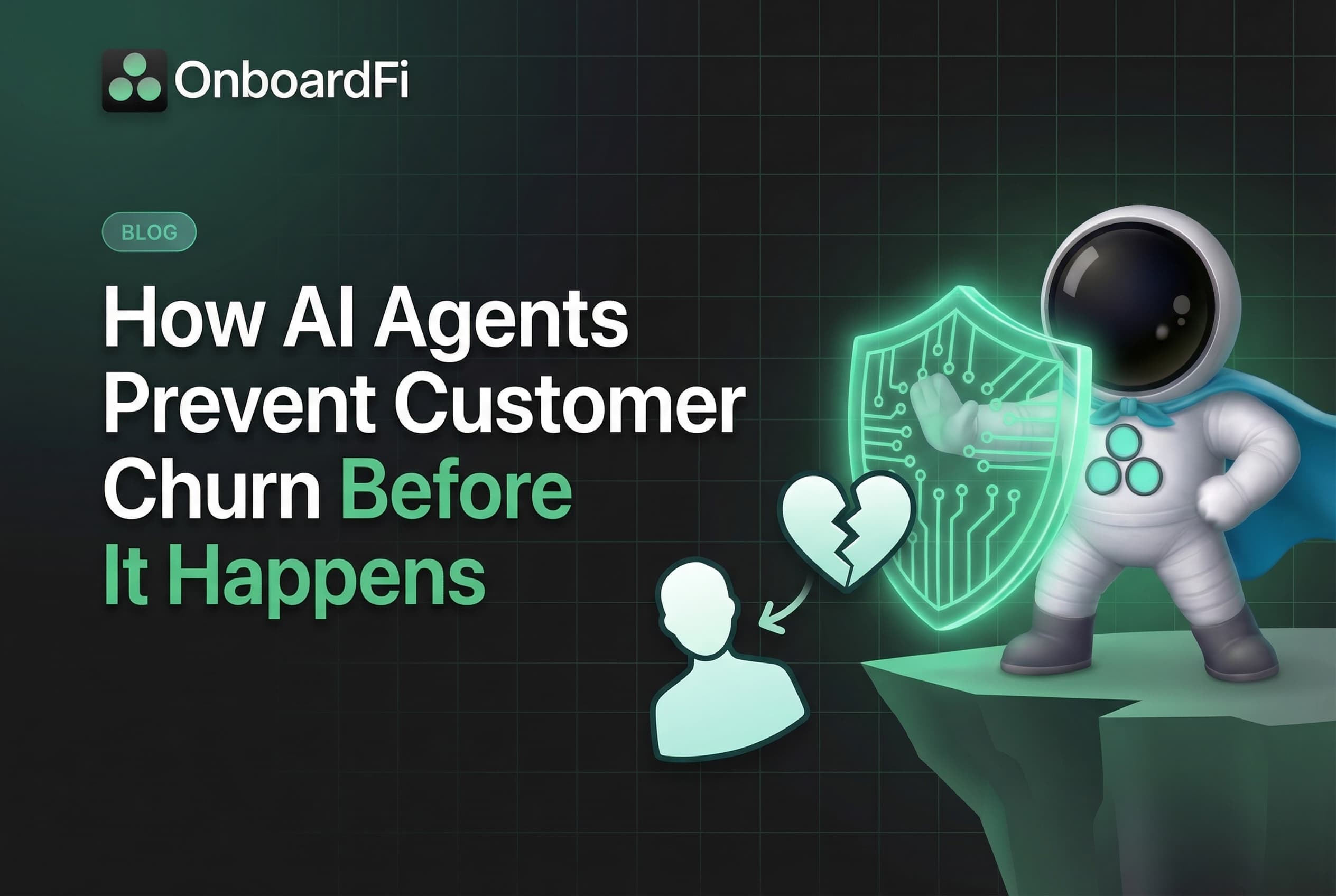
Churn is quiet. It doesn't announce itself with angry emails or dramatic phone calls. It shows up as a login that stops happening, a support ticket that never gets filed, a renewal conversation that keeps getting pushed back. By the time your team notices, the customer has already made their decision.
This is the fundamental problem with how most B2B companies handle retention: they treat it as a reactive function. Wait for the warning signs. Scramble to save the account. Run a post-mortem on why it happened. Repeat.
AI agents flip this entirely. They monitor, detect, and act on churn signals continuously — before a customer ever considers leaving.
The $1.6 Trillion Problem
Customer churn costs businesses a collective $1.6 trillion annually. And the math on retention vs. acquisition is well-established: acquiring a new customer costs 5 to 25 times more than retaining an existing one, according to research highlighted in the Harvard Business Review.
Despite this, most companies invest disproportionately in acquisition. Marketing budgets balloon while customer success teams stay lean. The result is a leaky bucket — you're pouring leads in the top while customers quietly drain out the bottom.
The fix isn't more CSMs. It's a workforce that can monitor every account, every signal, every day, without burning out. That's what AI agents do.
What Churn Actually Looks Like Before It Happens
Churn doesn't start with a cancellation request. It starts with behavioral shifts that are easy to miss when your CS team is managing 50+ accounts each:
- Usage drops — logins decrease, feature adoption stalls, or a power user goes quiet
- Support pattern changes — either a spike in frustrated tickets or, more dangerously, no tickets at all (they've stopped trying)
- Engagement decay — emails go unopened, check-in calls get declined, QBR attendance drops
- Sentiment shifts — subtle changes in tone during interactions, negative NPS responses, or lukewarm feedback
As SalesAi's breakdown on reducing churn notes, these signals are often "little things that add up" — a dip in usage here, a delayed response there. Individually, none of them triggers an alarm. Together, they paint a clear picture.
The problem is that painting requires someone watching constantly. Human CS teams can't do that across an entire customer base. AI agents can.
How AI Agents Intervene at Every Stage
Early Detection: Catching At-Risk Accounts 30% Faster
AI agents monitor customer health signals in real time — not in a weekly dashboard review, but continuously. They track usage patterns, support interactions, billing behavior, and engagement metrics simultaneously across every account.
According to EverAfter's research on AI-driven retention, companies using AI agents for predictive churn prevention catch at-risk accounts 30% faster than teams relying on manual monitoring. That speed matters — the difference between a save and a loss is often measured in days, not weeks.
When an AI agent detects a risk pattern, it doesn't just flag it in a dashboard. It acts: triggering a personalized check-in, surfacing relevant help content, or escalating to a human CSM with full context on what's happening and why.
Proactive Engagement: 40% Fewer Support Tickets
The counterintuitive truth about churn is that customers who complain are often the ones who stay. They're invested enough to push for a fix. It's the silent ones — the customers who stop engaging entirely — that leave.
AI agents solve this by initiating engagement before problems escalate. An embedded agent on your product can:
- Detect when a customer hits a friction point and offer contextual help immediately
- Reach out when usage patterns suggest confusion or underutilization
- Surface features the customer hasn't discovered that directly address their use case
- Send proactive check-ins when engagement drops below historical norms
The result? EverAfter reports a 40% reduction in support tickets — not because problems disappeared, but because they got resolved before they became tickets.
Personalized Retention at Scale
Every CSM knows that the best retention conversations are deeply personal: understanding the customer's goals, their specific pain points, what success looks like for them. The problem is delivering that personalization across hundreds or thousands of accounts.
AI agents maintain context for every customer interaction, building a continuous understanding of each account's health, goals, and engagement history. When a retention intervention is needed, the agent doesn't start from scratch — it draws on the full relationship history to deliver a response that feels 1:1, even at scale.
This isn't just theory. Companies implementing AI-driven personalization are seeing 20% better retention rates compared to generic retention playbooks.
Dynamic Health Scoring
Traditional health scores are static — they update quarterly, maybe monthly, based on a handful of metrics. By the time a score turns red, the damage is often done.
AI agents enable real-time health scoring that incorporates dozens of signals:
- Product usage depth and frequency
- Support interaction sentiment and resolution rates
- Billing patterns and payment timeliness
- Stakeholder engagement levels
- Feature adoption relative to initial goals
These scores update continuously, giving your team a living view of account health rather than a quarterly snapshot. More importantly, the AI agent acts on score changes automatically — no one needs to check a dashboard to know something needs attention.
The Human-AI Retention Model
Deploying AI agents for churn prevention doesn't mean removing humans from retention. It means redeploying them to where they're irreplaceable:
AI agents handle:
- Continuous monitoring across all accounts
- Pattern detection and early warning
- Proactive outreach for engagement drops
- Contextual help and feature education
- Health score maintenance and alerting
Human CSMs handle:
- Strategic account planning for top-tier customers
- Complex negotiations and escalations
- Relationship building that requires empathy and judgment
- Customer success insights interpretation and strategy
The data supports this model. Companies using AI agents alongside human CS teams report 15-25% retention improvements and a 40-60% reduction in manual CS tasks. Your team isn't doing less — they're doing higher-value work.
Where to Start
If you're losing customers and your CS team is already stretched thin, here's the practical starting point:
1. Deploy an Embedded Agent for Real-Time Intervention
An embedded AI agent on your product catches friction as it happens. Instead of waiting for a support ticket, the agent engages customers the moment they struggle — offering help, surfacing documentation, or connecting them to a human when the situation requires it.
2. Automate Onboarding to Prevent Early Churn
The highest-risk churn period is the first 90 days. If customers don't see value quickly, they leave. Automating your onboarding flow with AI agents ensures every customer gets consistent, guided setup — not just the accounts lucky enough to get a dedicated CSM.
3. Build Continuous Feedback Loops
AI agents can run ongoing micro-surveys, monitor sentiment in support interactions, and track product feedback — giving you a real-time pulse on customer satisfaction rather than a quarterly NPS snapshot.
4. Connect Signals Across the Stack
Churn signals live in your CRM, your product analytics, your support platform, and your billing system. AI agents pull these together into a unified view, identifying patterns that no single tool would catch on its own.
The Bottom Line
Churn is a labor problem disguised as a strategy problem. Every company knows they should monitor customer health, engage proactively, and intervene early. The gap isn't knowledge — it's capacity.
AI agents close that gap. They give every account the attention that used to be reserved for your top 10 customers. They catch signals your team can't possibly monitor manually. And they act fast enough to matter.
The companies that figure this out will retain more customers, grow more efficiently, and spend less time firefighting. The ones that don't will keep wondering why their bucket leaks.
OnboardFi deploys AI agents across the customer lifecycle — from first-touch qualification through onboarding to long-term retention. See how it works or read our guide on reducing onboarding time to start closing the gap.