The next wave of GTM software is clear: autonomous CRM, agentic sales assistants, and AI that promises to execute end-to-end workflows. The pitch sounds complete. The results usually are not.
The core problem is not whether AI can capture a lead signal. It can.
The core problem is what happens after the deal stage changes.
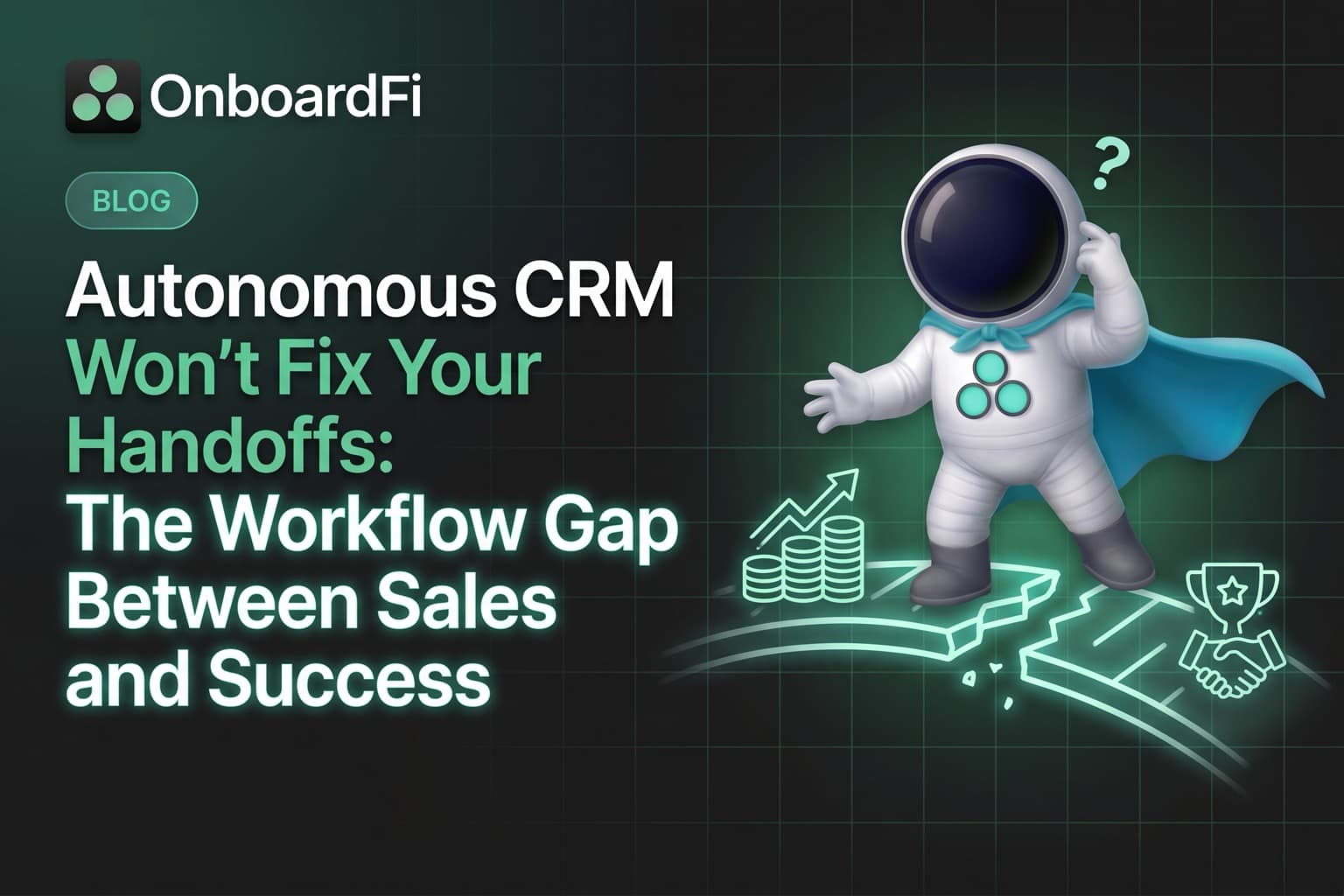
Teams are still dropping context between sales, onboarding, and customer success. And every dropped handoff adds delay, rework, and preventable churn risk.
Recent coverage of ServiceNow's autonomous CRM push highlights the same promise the market keeps hearing: move from intent to fulfillment in one system. That direction is right. But it also exposes the real operational gap most teams still have: they optimize the CRM record, not the lifecycle execution layer that customers actually experience (CMSWire, CX Today).
The Mistake: Confusing Data Continuity With Execution Continuity
Most rev teams celebrate when AI enriches CRM objects with better notes, summaries, and next-best actions. That's data continuity.
But customers do not buy data continuity.
Customers buy outcomes: fast onboarding, clear ownership, and progress without repeating themselves five times.
Execution continuity means:
- The implementation team receives the exact buying context, not a generic handoff doc.
- The first onboarding phase reflects the promises made in the sales call.
- Risks are surfaced early and routed to the right owner automatically.
- Every customer-facing interaction advances work, not just records it.
If those conditions fail, the CRM can look healthy while lifecycle performance degrades.
Where Handoffs Actually Break
1. Signal Capture Without Task Orchestration
Sales AI captures intent signals well: integration concerns, compliance constraints, timeline pressure, stakeholder politics.
Then the signal dies in a note field.
No accountable task is created. No due date is enforced. No cross-functional dependency is resolved. The result is follow-up debt, just delayed into post-sale operations.
2. Onboarding Starts From Templates, Not Conversations
Most onboarding motions still trigger from static templates. That's efficient for internal consistency, but blind to what the buyer explicitly said they need.
A customer who emphasized security review urgency should not receive the same week-one path as a customer focused on activation speed. If onboarding ignores conversational context, teams lose the trust they gained in discovery.
3. Success Teams Inherit Ambiguity
By the time accounts reach success, key facts are often ambiguous:
- What did the champion promise internally?
- Which integration dependencies were blockers?
- Which use case drove the purchase decision?
Success managers spend their first weeks reconstructing context instead of compounding value.
Why This Matters More in 2026
The market has accepted AI SDR and agentic GTM tooling as standard. You can see it across major launches and GTM narratives. The new bottleneck is no longer top-of-funnel conversation volume.
The bottleneck is lifecycle execution quality after those conversations.
This is why teams with aggressive AI adoption still miss expansion targets:
- They increased signal intake but not handoff precision.
- They automated messaging but not cross-stage accountability.
- They improved sales speed but not onboarding reliability.
In short: more AI did not automatically produce better customer outcomes.
The Operator's Framework: Fix the Workflow Gap
If you want autonomous CRM initiatives to produce real revenue outcomes, audit handoffs as a system, not a sequence of meetings.
Step 1: Define Required Handoff Artifacts
For every closed-won account, require structured handoff payloads generated from conversation context:
- Primary success metric agreed in sales
- Known blockers and dependencies
- Stakeholder map with decision dynamics
- Implementation risks and mitigation owners
No payload, no stage progression.
Step 2: Tie Signals to Enforced Work
Every high-intent or high-risk signal should create an explicit task with:
- Owner
- Due date
- Escalation path
- Resolution criteria
This is where most systems fail. They summarize well and enforce poorly.
Step 3: Make Customer-Facing Progress Visible
Customers should see lifecycle progress in a shared environment, not via scattered email updates. If the customer cannot see status, your internal system likely cannot maintain accountability either.
This is exactly why teams move from static CRM workflows to lifecycle-aware execution surfaces like customer portals and embedded agents (Customer Portal, Embedded Agent).
Step 4: Use AI to Surface Risk Before the QBR
Risk detection should run continuously from conversation and task activity, not quarterly from lagging health scores.
The right question is not "what is the account score?"
The right question is "which accounts are drifting from promised outcomes this week, and what action must be taken today?"
What Good Looks Like
Teams that close the workflow gap do three things consistently:
- They treat conversational enrichment as operational input, not CRM decoration.
- They convert intent and risk signals into accountable execution.
- They keep customers and internal teams aligned in one lifecycle system.
When those are in place, autonomous CRM becomes an accelerator. Without them, it becomes another layer of optimistic metadata.
Bottom Line
Autonomous CRM is directionally correct, but insufficient on its own.
If sales-to-success handoffs are still manual, ambiguous, or disconnected from real customer conversations, revenue leakage will continue no matter how advanced your AI summaries look.
The next advantage is not having more AI agents.
The next advantage is having lifecycle execution that actually honors what those agents learn.
If you want to eliminate handoff failure and run customer lifecycle execution from one conversation-aware system, start with OnboardFi's embedded AI agent, then benchmark your current sales-to-success flow against The Sales Execution Gap and The AI SDR Arms Race.