Revenue AI has a blind spot.
The market is finally taking context seriously. ZoomInfo is pushing GTM context graphs into AI workflows, Tealium just launched a Context API for AI agents, and Jedify raised fresh capital around the idea that enterprise AI agents still lack the business context they need.
That shift is real.
It is also incomplete.
Most revenue AI systems still treat context as a sales problem.
They capture account data, prospect research, call summaries, and maybe a few buying signals. Then the deal closes and the system loses sight of the most valuable data in the lifecycle: onboarding friction, execution delays, stakeholder drop-off, and the customer conversations that determine whether revenue compounds or churn starts early.
That is the mistake.
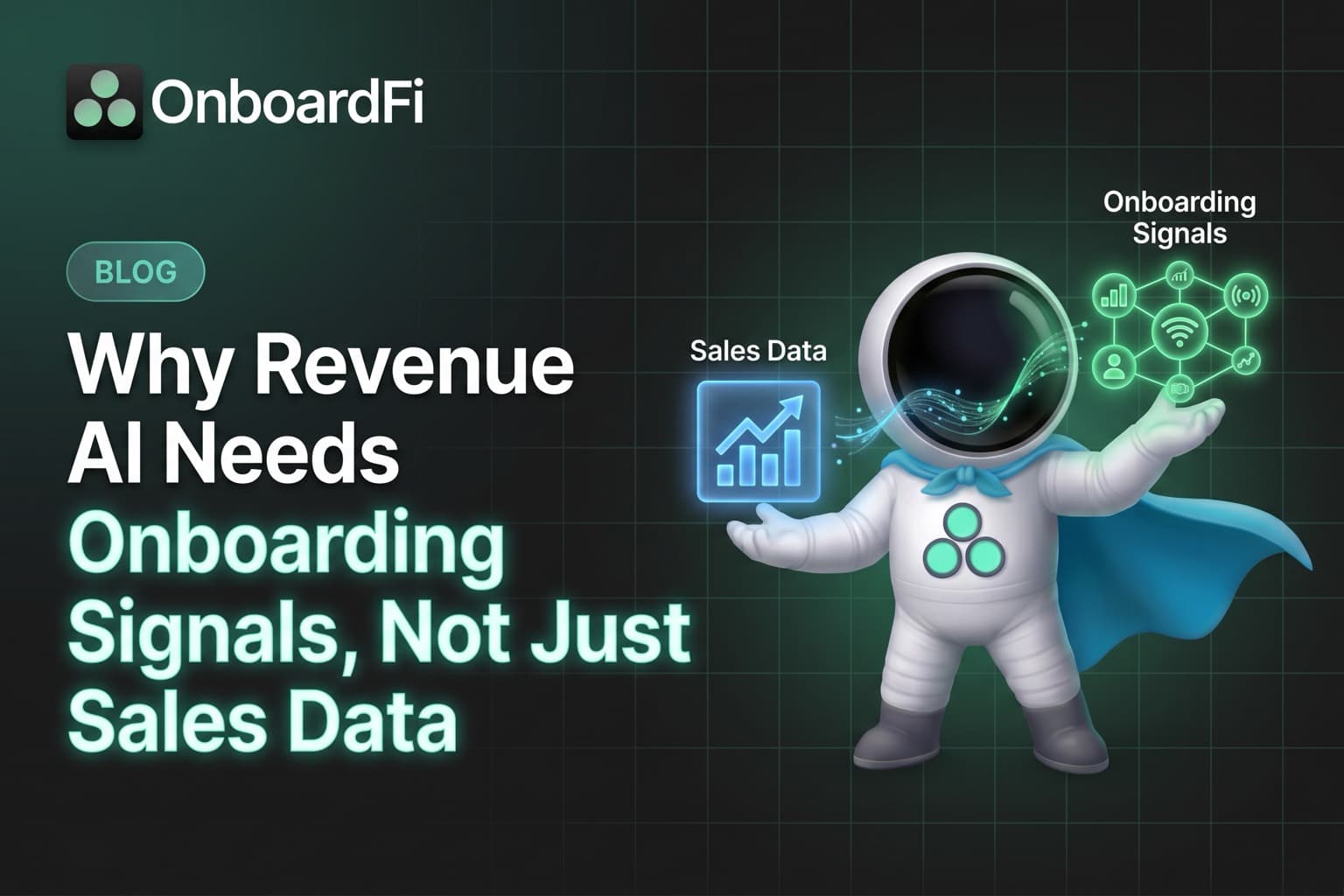
Revenue AI does not need more pre-sale data alone. It needs onboarding signals.
Sales Data Explains The Opportunity. Onboarding Data Explains The Reality.
Sales data tells you why a deal might happen.
Onboarding data tells you whether the promise survives contact with execution.
That difference matters because post-sale is where customer truth gets exposed fast:
- which integration dependency was never really solved
- which internal stakeholder is not showing up
- which use case sounded urgent in discovery but has no owner in implementation
- which timeline pressure is turning into delay
- which account is quietly drifting before a CSM ever calls it risk
This is the same lifecycle problem underneath The Agentic GTM Context Gap and Autonomous CRM Won't Fix Your Handoffs. AI gets faster at producing and summarizing activity. It still breaks when context stops being operational after the sale.
If your system only understands buyer intent up to closed-won, it does not understand revenue. It understands pipeline.
Why This Blind Spot Is Getting More Dangerous
The current wave of AI launches is pushing teams toward broader orchestration:
- Adobe is positioning agentic CX orchestration as a new operating layer with its CX Enterprise Coworker launch.
- Gainsight is leaning into an agentic retention stack because post-sale engagement is where expansion and churn are decided.
- OnRamp is publishing data and product direction around AI customer onboarding because teams want faster time-to-value, not prettier kickoff decks.
The market is moving toward lifecycle AI whether most revenue teams are ready or not.
But many teams are still operating from a shallow definition of context:
- firmographics
- title and role
- engagement with outbound
- meeting summaries
- next-step notes in the CRM
Useful? Yes.
Sufficient? No.
That stack can help book the meeting and still miss the exact signals that determine whether the account activates, expands, or stalls in week one.
What Onboarding Signals Actually Tell You
Onboarding signals are not generic customer success metrics. They are execution signals that reveal whether revenue momentum is holding or decaying.
The important ones are usually simple:
- time from signed deal to first customer action
- unresolved blocker age by account
- repeated implementation questions across channels
- stakeholder participation gaps
- missed milestones against the buying timeline
- feature adoption compared with the original use case
- sentiment shifts inside onboarding conversations
These signals matter because they expose the difference between what was sold and what is actually happening.
A CRM summary might say:
“High-intent buyer. Security review complete. Fast implementation needed.”
Onboarding signals might show:
- security review is still waiting on customer counsel
- the internal admin never joined the portal
- the promised champion has not completed a first task
- procurement pressure is slowing activation by five days already
That is the real state of revenue.
Without that layer, AI can sound intelligent while still making bad decisions from incomplete context.
Three Reasons Revenue AI Needs Onboarding Signals
1. Closed-won is where the most expensive surprises start
Revenue leaders still talk about handoffs like an operational nuisance. They are not. They are where future churn, delayed expansion, and support load begin.
The first serious signal of revenue risk often appears after the deal is marked won:
- kickoff gets delayed
- credentials do not arrive
- a technical blocker is discovered late
- the original use case has no internal owner
- the buyer who drove urgency disappears
If AI cannot see those signals, it cannot protect the revenue it helped create.
2. Onboarding reveals whether your sales context was actually accurate
Plenty of systems claim to preserve context from the sales conversation.
Very few test that context against execution truth.
Onboarding is where you find out whether:
- the buyer's real priority was speed or control
- the integration requirement was mandatory or optional
- the customer needed a guided rollout or a fast self-serve path
- the promised value story matches real adoption behavior
That feedback loop should not live in someone's head or a QBR prep doc. It should become machine-readable lifecycle context that improves the next decision.
3. Retention starts before the onboarding project looks unhealthy
By the time a health score turns red, the account has often been drifting for weeks.
The earliest retention signals are usually hidden in onboarding behavior:
- customers stop replying
- tasks remain untouched
- repeated confusion goes unresolved
- value milestones slip without explicit escalation
That is why The Demo-to-Onboarding Drop-Off matters so much. Week one is not a delivery detail. It is the first live test of whether your revenue system can carry context into action.
The Better Operating Model
Revenue AI should work across the entire lifecycle, not just the front end of it.
That means three things.
Capture the original conversation in a usable format
The first job is still conversational enrichment.
An Embedded Agent should capture what the buyer actually wants, what is broken today, what urgency exists, and what constraints are likely to slow the account later. That is still the highest-value starting point.
Turn onboarding into a context-rich execution surface
The second job is making that context actionable after the deal.
A Customer Portal should not just show generic tasks. It should carry forward the specific use case, blockers, owners, and milestones that came out of the buying process. Customers and internal teams should see the same lifecycle reality.
Keep learning from every post-sale interaction
The third job is feeding onboarding and success signals back into the system.
If an account keeps stalling on integration work, the system should know that.
If a specific stakeholder role repeatedly becomes the activation bottleneck, the system should know that.
If certain promises in discovery correlate with longer time-to-value, the system should know that too.
That is what makes revenue AI better over time. Not more summaries. Better lifecycle memory.
What Teams Should Measure Instead
If you want onboarding signals to matter, your metrics need to change.
Stop treating revenue AI as a meetings-and-notes machine.
Track:
- signed-deal to first customer action
- signed-deal to first delivered value
- percentage of accounts with blockers older than 48 hours
- stakeholder participation rate during onboarding
- activation progress against the original buying use case
- time from risk signal detection to action taken
These are not vanity metrics. They tell you whether context is surviving the handoff from sales to delivery to success.
They also align with what OnboardFi is built to do: connect conversational intake, customer-facing execution, and lifecycle intelligence in one system.
Bottom Line
Revenue AI is heading in the right direction.
Context graphs, orchestration layers, and AI coworkers all point to the same truth: systems need better context to make better decisions.
But if that context stops at the sales stage, the system is still blind where revenue becomes real.
Onboarding signals are not secondary data. They are the proof of whether your revenue motion actually works.
If you want AI to protect expansion, accelerate time-to-value, and catch churn risk earlier, start treating onboarding as a revenue intelligence layer instead of a post-sale checklist.
If you want to operationalize that model, start with OnboardFi Embedded Agent, connect it to a shared Customer Portal, and build a lifecycle system that learns from every customer conversation after the deal.