Agentic GTM is having its moment.
Apollo is now positioning AI workflows as a core growth surface, reporting nearly 20,000 weekly users running agentic GTM workflows. SaaStr says its AI-heavy operating model helped generate 614 meetings with a three-human, 21-agent stack. The market is no longer debating whether AI agents belong inside revenue teams. It is debating where they create the most leverage.
Most teams are answering that question with outbound automation.
More prospecting. More sequences. More auto-research. More meetings booked without adding headcount.
That is real progress.
It is also where a lot of teams stop thinking.
Because booking more meetings is not the same thing as understanding buyer intent.
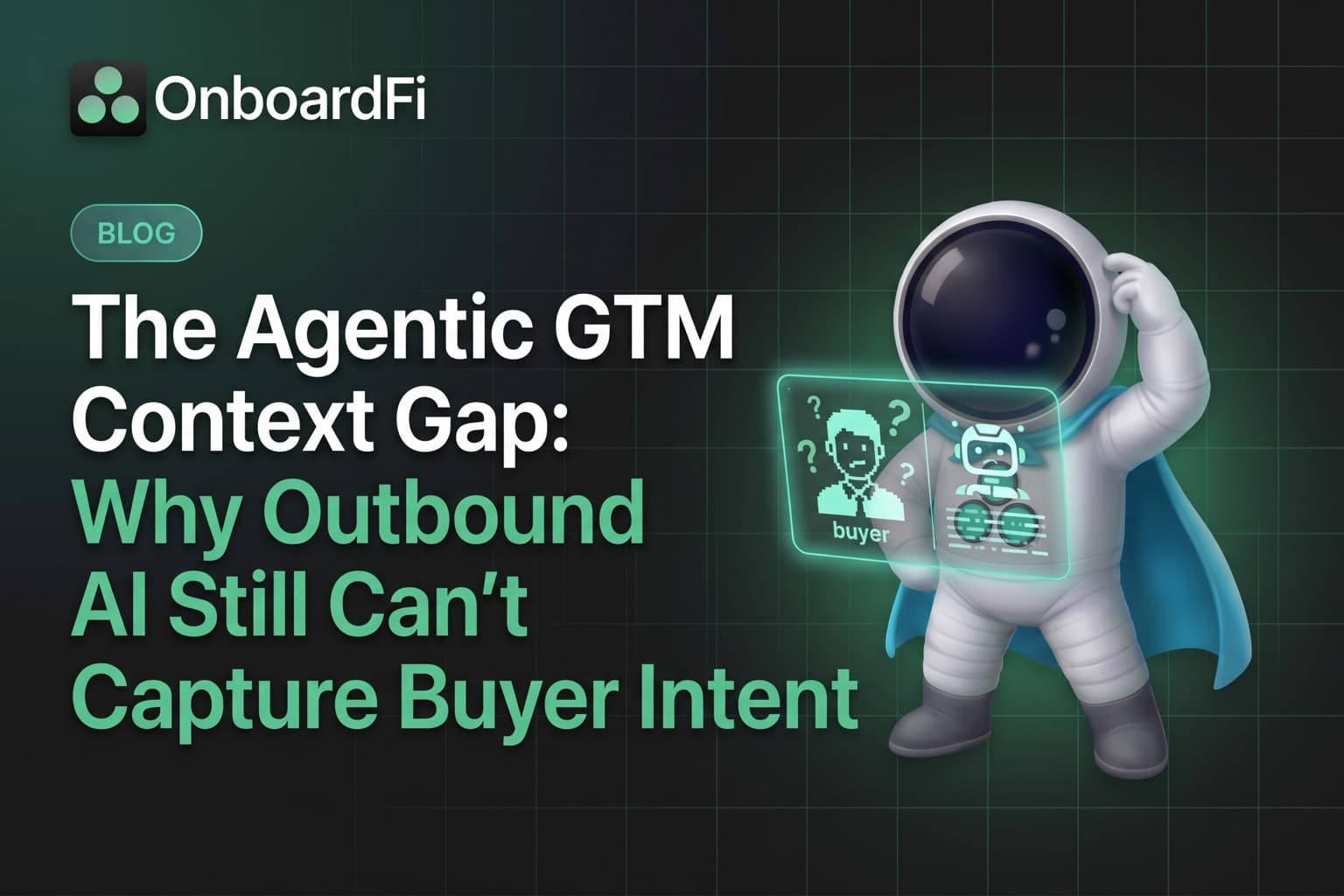
That is the context gap.
What Outbound Agentic GTM Does Well
Outbound agents are legitimately useful when the job is workflow compression.
They can:
- find target accounts faster
- enrich records at scale
- launch sequences without manual setup
- follow up consistently across time zones
- keep outbound volume moving when human capacity would stall
That matters. If your old GTM motion depended on reps manually pulling lists, writing first-pass messaging, and remembering every follow-up window, agentic execution is a real step up.
The category shift is obvious in current market signals:
- Apollo’s AI assistant rollout pushes the market toward natural-language workflow execution
- ZoomInfo’s GTM.AI launch frames verified context as the layer every agent needs
- TitanX’s 2026 AI SDR assessment makes the tradeoff explicit: AI SDRs can scale activity, but they are not a clean one-to-one replacement for human sellers
The problem is not that outbound agents fail to execute.
The problem is that execution without conversational understanding creates a new bottleneck.
The Problem: Workflow Velocity Is Not Buyer Understanding
Outbound systems are optimized for motion. Buyer intent is shaped in conversation.
That difference matters more than most teams admit.
A rep can receive a perfectly enriched record and still walk into a call blind on the details that actually determine whether a deal moves:
- why the buyer is looking now
- what is broken in the current workflow
- what internal constraint will slow the deal
- which handoff risk will show up after closed-won
- what emotional trigger is driving urgency
Demographic enrichment helps you understand who the buyer is on paper.
Conversational enrichment helps you understand what the buyer is actually trying to solve.
Those are not interchangeable.
Why the Context Gap Keeps Showing Up
There are three structural reasons outbound-first agentic GTM still misses intent.
1. The system over-weights proxy signals
Most outbound stacks are built around signals like:
- title
- company size
- industry
- hiring trends
- buying intent topics
- engagement with outbound touches
Useful? Yes.
Sufficient? No.
Those signals tell you a buyer might be relevant. They do not tell you what the buyer said when they finally engaged.
That is why the same company can look “high intent” in a dashboard and still convert poorly once the human conversation begins.
2. The conversation happens too late in the operating model
In outbound-heavy systems, conversation is often treated as the reward for good automation.
The workflow logic is:
- identify account
- enrich record
- launch outreach
- book meeting
- let the human figure out the rest
By the time the real conversation happens, the system has already done most of its work. The highest-value data arrives at the exact moment the automation layer steps back.
That is backwards.
The richest signal is not the list match. It is the live conversation.
3. Context continuity breaks after the first meeting
Even when a meeting gets booked, buyer context rarely survives cleanly into the next stage.
This is the same failure pattern behind The AI SDR Arms Race and The Sales Execution Gap: the stack captures activity faster than it preserves execution-ready context.
So teams end up with:
- transcripts nobody operationalizes
- summaries that never become owner-specific next steps
- onboarding teams restarting discovery from scratch
- customer success inheriting accounts with generic CRM notes instead of real buyer language
Pipeline volume goes up. Continuity does not.
What Conversational Enrichment Changes
Conversational enrichment starts from a different premise:
the highest-value customer data is not appended from a database. It is captured in dialogue.
When an AI agent handles inbound qualification well, it does more than route leads. It captures:
- why the buyer came in today
- which workflow is failing
- what “good” looks like in the buyer’s words
- what concern could stall procurement or onboarding later
- how ready the buyer actually is
That is the data sales teams use to close deals faster.
It is also the data onboarding and customer success teams need if they want to preserve momentum after the sale.
This is where Embedded Agent matters more than another outbound automation layer.
An embedded conversational agent sits at the moment of intent. It qualifies in real time, captures decision-grade context, and creates a brief that a seller or downstream workflow can actually use.
The Better Operating Model: Inbound Context, Then Execution
The winning model is not outbound or inbound.
It is conversational context first, execution second.
That means:
Capture intent where buyers choose to engage
If a buyer lands on your site, asks about implementation, compares pricing models, or wants to know whether your product can replace a manual follow-up process, that conversation is the asset.
Do not reduce it to a contact record plus a few tags.
Convert the conversation into workflow ownership immediately
Every meaningful signal should create a deterministic next step:
- implementation concern -> attach delivery context before the deal closes
- integration objection -> route to the right technical owner with transcript excerpts
- pricing friction -> create a same-day follow-up path with preserved rationale
No generic “follow up later” state.
Preserve the intent narrative into onboarding and success
This is where most stacks still fail.
If post-sale teams cannot see the exact reasons the customer bought, onboarding slows down and churn risk starts earlier than the dashboard suggests.
That is why the operating layer needs to extend beyond booked meetings into shared lifecycle execution surfaces like a Customer Portal and dedicated sales workflows.
The Strategic Mistake Revenue Teams Are About to Make
A lot of teams are about to spend the next 12 months optimizing the wrong thing.
They will measure:
- sequences launched
- meetings booked
- agent utilization
- contacts enriched
Those metrics will improve.
And they will still wonder why pipeline quality feels inconsistent, why handoffs feel fuzzy, and why onboarding starts with avoidable rework.
Because the stack is getting faster at producing activity, not better at preserving buyer understanding.
That is the context gap.
The companies that win the next phase of agentic GTM will not be the ones with the most automated outbound motion.
They will be the ones that capture the best conversations, operationalize them immediately, and keep that context alive across the entire lifecycle.
That is a different category of leverage.
If your current GTM stack can launch ten workflows but still cannot tell your onboarding team what the buyer actually cared about, you do not have autonomous execution.
You have faster lead handling with delayed context loss.
If you want to fix that, start with OnboardFi Embedded Agent and build the workflow around conversational enrichment instead of treating it like a nice-to-have after the meeting is already booked.