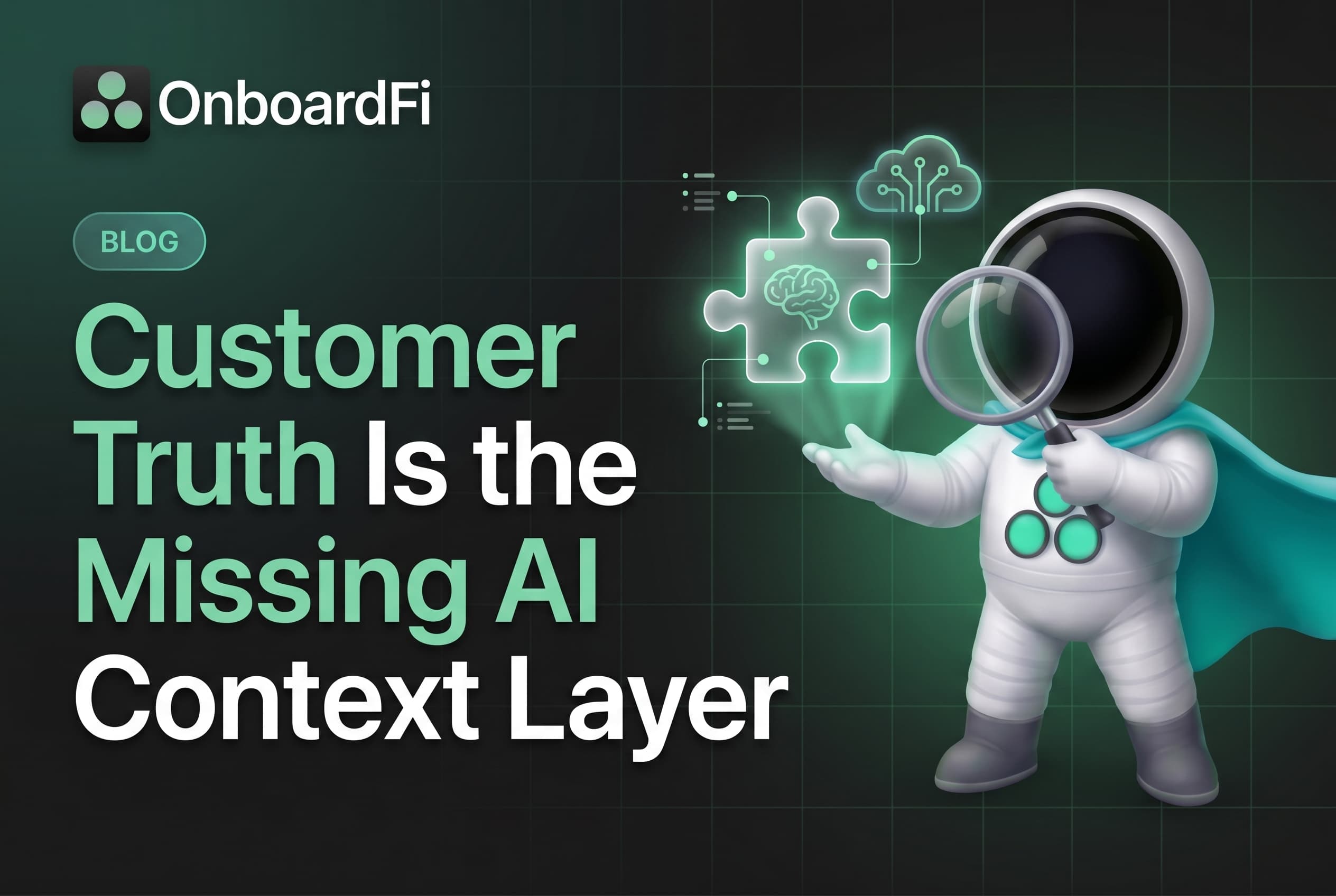
Customer Truth Is the Missing AI Context Layer
The market has a new favorite phrase: context layer.
Every week, another vendor announces a new way to unify revenue data, ground AI agents in business context, or modernize the customer record. The story sounds right. AI needs context. Fragmented systems create bad decisions. Teams need one place to reason about the business.
All true.
The problem is that most of these launches still define context too narrowly. They unify GTM data, conversation data, or record data. They do not unify customer truth.
Customer truth is not just what happened before the deal. It is what is happening after the deal:
- whether kickoff slipped
- whether the right stakeholder showed up
- whether onboarding tasks stalled
- whether the customer is repeating the same objection they raised during evaluation
- whether the promised use case is actually getting adopted
That is the context AI systems still miss.
Recent market signals make the gap obvious:
- SiliconANGLE argued that enterprise AI needs a context layer.
- CIO argued that golden records are no longer enough in the age of AI agents.
- Diginomica covered HubSpot's new Revenue Hub and the broader push to solve fragmented revenue data.
- The Pedowitz Group reminded readers that GTM strategy is broader than marketing because it spans the full customer lifecycle.
The direction is correct. The center of gravity is still wrong.
The Market Is Solving Data Fragmentation, Not Lifecycle Fragmentation
Most context-layer products are built to answer questions like these:
- Which account is most likely to buy?
- Which rep activity moved pipeline?
- Which revenue signal is missing from the CRM?
- Which agent should receive the next GTM task?
Those are useful questions.
They are also pre-sale questions.
The harder operational questions arrive later:
- Did the customer reach first value?
- Is implementation blocked because no internal admin was assigned?
- Did the onboarding plan reflect the buying context from the original sales conversation?
- Is the account healthy because adoption is real, or just because the record says "closed won" and no one has updated the next field yet?
This is the gap we pointed to in Agentic Sales Is Not Customer Lifecycle. Revenue systems have become much better at qualifying, routing, and scoring. They are still weak at preserving continuity once the deal becomes a customer relationship.
A context layer that cannot see post-sale reality is not customer truth. It is sales memory.
Why Golden Records Still Break Under AI
The classic enterprise answer to fragmentation was the golden record: one clean customer profile, deduplicated and reconciled across systems.
That model worked when most business workflows were human-paced and record-driven.
AI agents break that assumption.
Agents do not just read fields. They act on incomplete, moving, contradictory context. They need to know what was promised, what was delivered, what changed this week, and what the customer actually said when they hit friction.
That is why the CIO argument matters. A static golden record may tell you:
- account name
- owner
- deal size
- segment
- renewal date
It usually will not tell you:
- that onboarding is two weeks late because the security review never started
- that the executive sponsor has gone silent
- that the customer keeps asking for the same integration help across three channels
- that the original use case from the sales cycle has quietly changed
Those are not edge cases. Those are the operating facts that determine retention.
This is also why How AI Agents Prevent Customer Churn Before It Happens matters as a companion read. Churn rarely begins with a clean record update. It begins with signals that look small in isolation and obvious only in sequence.
GTM Context Is Not the Same Thing as Customer Truth
A lot of current AI infrastructure is being built around GTM context graphs, revenue hubs, and conversation intelligence layers. That makes sense. Those systems are closer to pipeline and easier to measure.
But GTM context and customer truth are not interchangeable.
GTM context usually includes:
- account firmographics
- pipeline stage
- call summaries
- email engagement
- intent data
- contact hierarchy
Customer truth includes different signals:
- onboarding phase velocity
- blocker age
- unanswered implementation dependencies
- portal engagement by role
- repeated support or enablement questions
- project progress relative to the original buying promise
One category tells you whether the deal might close.
The other tells you whether the customer relationship is actually progressing.
If your AI layer only understands the first category, it will look smart in pipeline reviews and blind in lifecycle execution.
The Real Context Layer Has to Survive the Handoff
Most teams do not lose context because they lack another dashboard. They lose context because every stage resets the operating surface.
The prospect speaks with an AI SDR. Then sales takes over. Then onboarding starts in a project tool. Then customer success moves to another workspace. Then support answers questions somewhere else.
Each transition destroys continuity.
That is the same lifecycle failure behind The Demo-to-Onboarding Drop-Off: the system treats every stage boundary as a fresh start, even when the customer is carrying the same objective and the same constraints from one phase to the next.
A real context layer has to preserve the thread across those boundaries.
That means the system should be able to carry forward:
- the original buying trigger
- the promised outcome
- the implementation risks already discovered
- the stakeholders involved
- the questions still unresolved
When that thread survives, AI can do useful work after the sale. Without it, every new team gets a cleaner record and a worse understanding.
What This Means for Revenue Leaders in 2026
The practical mistake is assuming that better AI context means more data sources upstream.
Sometimes it does.
But in customer lifecycle systems, the higher-leverage move is usually different: capture fewer abstract signals and more operationally decisive ones.
Ask these questions instead:
- Can our AI see whether onboarding is actually moving?
- Can it tell which blocked task is most likely to create churn risk?
- Can it connect a buyer objection from pre-sale to a post-sale stall?
- Can it see customer-facing execution, not just internal seller activity?
If the answer is no, then the business does not have a customer truth layer yet.
It has AI enrichment around one department.
Where OnboardFi Fits
OnboardFi is built around the idea that context should not reset when the lifecycle changes.
That is why the architecture is not just a sales agent or a reporting layer.
- The embedded AI agent captures live buyer intent before form friction kills it.
- The customer portal keeps that context visible once onboarding and delivery begin.
- The lifecycle system keeps phases, tasks, stakeholder access, and customer interactions in one operating surface instead of scattering them across separate tools.
That matters because customer truth is created in the work itself.
Not in the cleaned CRM object. Not in the summary after the meeting. Not in the revenue graph alone.
It is created when the system can see what the customer needs, what is blocked, and what has or has not moved since the promise was made.
The Context Layer Test
If you are evaluating a revenue hub, context graph, or AI agent platform this quarter, use this test:
Can the system explain why a customer who looked healthy at close is now at risk three weeks later?
If it can only answer with pipeline history, contact enrichment, or call recaps, it is not showing customer truth.
If it can answer with lifecycle signals like blocker age, onboarding lag, missing stakeholder activity, and unresolved adoption friction, you are much closer.
That is the bar.
The market is right that AI needs context.
The next step is being precise about which context actually matters.
Because in customer lifecycle work, the missing layer is not just GTM data. It is customer truth.
If you want to see how OnboardFi turns conversational and lifecycle signals into one operating layer, start with the embedded agent and then look at how that context carries into the customer portal.