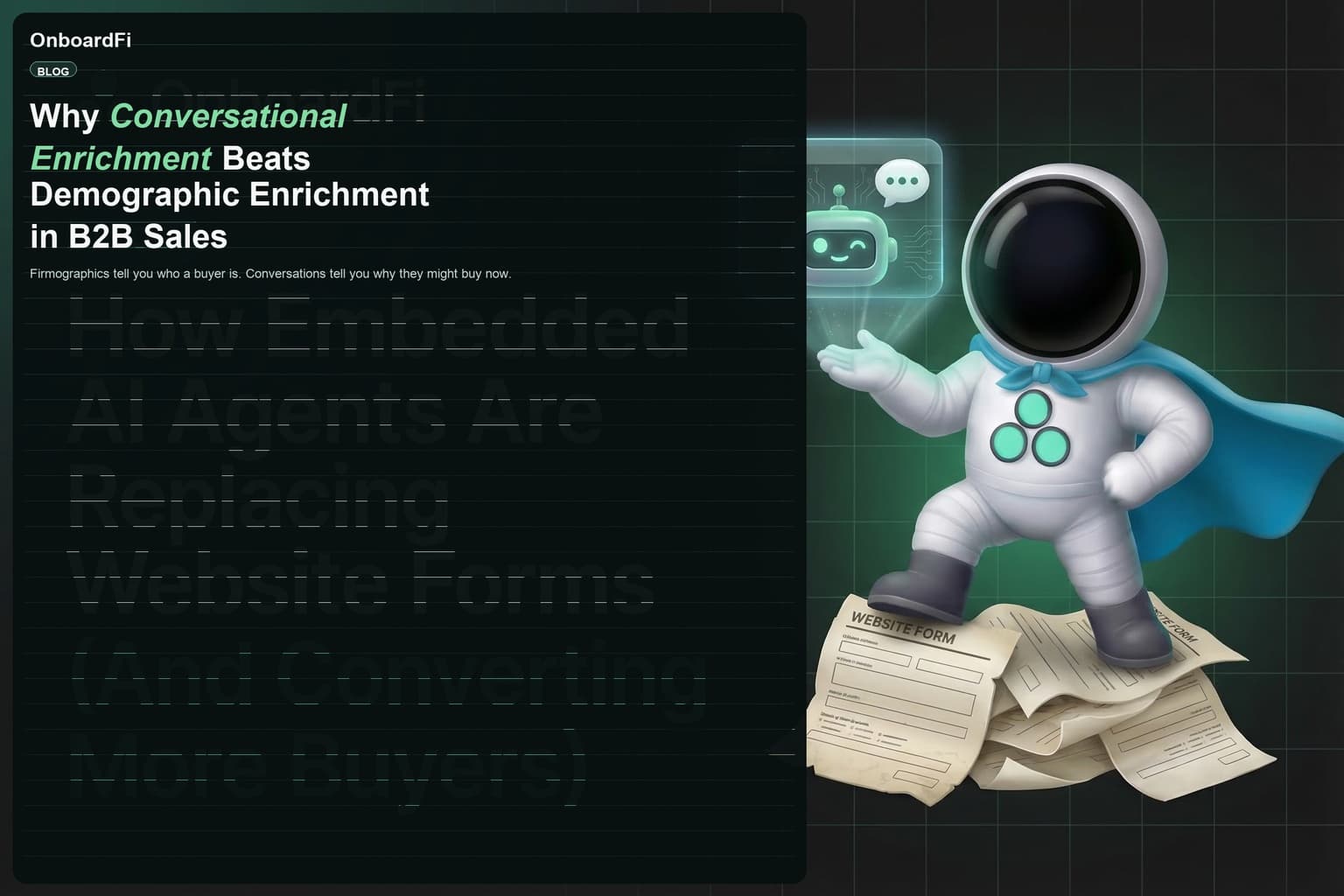
Most B2B teams still confuse contact data with buying intelligence.
They spend money enriching records with company size, industry, funding stage, job title, territory, and tech stack. Then they call that lead qualification.
It is not.
Demographic enrichment is useful. It helps you sort accounts, route ownership, and decide who belongs in a campaign.
But it does not tell you the thing revenue teams actually need when a buyer is finally ready to engage:
- what the buyer is trying to fix
- why the problem matters now
- what objection will stall the deal
- which workflow is already breaking internally
- what a successful outcome looks like in the buyer's own words
That is where conversational enrichment wins.
Demographic Enrichment Solves a Different Problem
Traditional enrichment tools are built to answer identity questions.
They help you understand:
- who the company is
- what role the contact holds
- how large the account might be
- whether the account fits your ICP on paper
That matters at the top of funnel. It is better than guessing.
But it is still proxy data.
Even the strongest CRM enrichment programs are fundamentally trying to improve data quality inside the record itself. ZoomInfo's own content on CRM data enrichment frames the value around cleaner records, stronger segmentation, and more complete account context. That is useful operational hygiene. It is not the same thing as understanding active intent.
A VP of Customer Success at a 300-person SaaS company might be a great-fit contact.
That still does not tell you whether they are trying to reduce onboarding delays, recover churn risk, replace a broken portal workflow, or shorten time-to-value before renewal season.
A clean record is not a clear buying signal.
The Problem With Proxy Data
The closer a buyer gets to a decision, the less useful proxy data becomes.
At that point, the gap is not "who are they?" It is "what are they dealing with right now?"
This is why teams that optimize for lead routing alone still end up with weak follow-up.
A seller gets a record that says:
- title: VP Marketing
- company size: 200 employees
- industry: B2B SaaS
- source: website
That is demographic enrichment.
What the seller actually needs is:
- they are trying to replace a static demo flow before Q4 planning
- they need lead follow-up to happen within minutes, not days
- sales and onboarding are dropping context after the first meeting
- they are worried a chatbot will feel generic and damage the brand
That is conversational enrichment.
One gives you profile data. The other gives you decision context.
Conversations Capture the Data That Forms Miss
This is not just a positioning argument. It is a data-quality argument.
Current research around conversational marketing keeps landing on the same point: real-time dialogue captures richer context than static intake.
TechFunnel's recent piece on how AI chatbots replace forms makes the obvious but still underappreciated point. Buyers no longer want to submit a form and wait. They want immediate interaction while intent is still high.
That speed matters.
But the more important shift is what gets collected during the conversation itself.
Gnosari's breakdown of how AI conversations collect better data than forms reinforces the same pattern: conversations surface nuance, sequencing, and follow-up detail that fixed fields do not.
A form can ask for company name, email, and team size.
A conversation can uncover:
- the exact trigger event that caused the buyer to look for a solution
- the manual workflow they want to eliminate
- the internal politics affecting urgency
- the operational risk if nothing changes this quarter
That is a completely different class of signal.
Why This Matters More in B2B Sales
B2B deals are rarely blocked by lack of surface-level data.
They are blocked by missing context at handoff.
This is the same failure pattern behind The Agentic GTM Context Gap, The Sales Execution Gap, and The Self-Serve Demo Trap.
Teams are improving activity volume faster than they are improving context quality.
That creates three predictable problems.
1. Qualification sounds precise but stays shallow
A record looks complete, but the seller still has to rediscover the problem live on the call.
2. Follow-up gets generic
Without real conversational context, the next touch sounds like every other nurture email in the market.
3. Post-sale teams inherit the account blind
Onboarding and customer success end up restarting discovery because the real reason the buyer bought never made it into the operational layer.
That is why conversational enrichment matters beyond lead capture.
It improves the entire lifecycle.
Conversation Data Is Better CRM Input
The strongest argument for conversational enrichment is not that it replaces CRM enrichment.
It is that it makes CRM enrichment more useful.
AskElephant's framing of how conversation data fills CRM gaps automatically is directionally correct: conversation data gives the record the missing context needed for better follow-up.
That is the right mental model.
CRM fields are still necessary.
But they should be downstream from the conversation, not treated as the whole story.
Once a buyer tells you what they are actually trying to solve, your systems can do smarter work:
- score intent with more accuracy
- route opportunities based on actual need, not just firmographic fit
- brief AEs before the first meeting
- prepare onboarding teams before the deal closes
- surface risk and expansion signals later in the lifecycle
That is how data becomes operational.
What Conversational Enrichment Looks Like in Practice
In practice, conversational enrichment means your AI agent is not just collecting a lead.
It is collecting a brief.
A strong inbound agent should capture:
- problem statement
- current workflow friction
- timing and urgency
- stakeholder context
- implementation concerns
- objections or hesitation
That is what a well-designed Embedded Agent should do.
And once that context exists, it should not die in a transcript.
It should carry into the next system your team uses to execute work. That is where a shared Customer Portal and lifecycle-specific workflows like Use Cases: Sales matter. The goal is not "better chat." The goal is preserving the buyer's context across every stage that follows.
The Competitive Difference Is Not More Data. It Is Better Data.
Most B2B teams already have too much data.
They do not need another dashboard full of enriched attributes.
They need fewer blind spots.
Demographic enrichment tells you whether someone resembles a likely buyer.
Conversational enrichment tells you whether they are acting like one.
That difference gets sharper as AI SDR tooling expands.
Even the current wave of inbound AI SDR tooling is increasingly optimized around speed and automation. Lists of inbound AI SDR platforms make the category momentum obvious. But if the output is still just a cleaner form replacement with thin context, then the handoff problem survives.
The real moat is not just responding faster.
It is learning more from the response.
The Shift Revenue Teams Should Make Now
If your team is still measuring intake quality mainly by completed forms, enriched records, or routing speed, the model is too narrow.
A better question is:
what useful context does your team have before the first meaningful human follow-up?
If the answer is still mostly fields and tags, then your qualification system is underpowered.
The best teams will start optimizing for:
- intent clarity
- objection capture
- workflow-specific context
- handoff quality
- lifecycle continuity
That is what conversational enrichment improves.
It does not make demographic enrichment irrelevant.
It makes it secondary.
The Bottom Line
Demographic enrichment helps you identify the account.
Conversational enrichment helps you win it.
That is the shift.
In B2B sales, the most valuable signal is not just who the buyer is. It is what the buyer says when given the chance to explain the problem.
If your team still relies on static forms and profile data as the primary qualification layer, you are asking your sellers and onboarding teams to do discovery twice.
Start with the conversation instead.
That is how you collect better data, route better follow-up, and preserve the context that actually moves deals forward.
If you want to see what that looks like in production, start with OnboardFi Embedded Agent. It captures the context forms miss, turns it into operational input, and gives revenue teams a cleaner handoff from first interaction to lifecycle execution.