Most B2B teams fixed one problem and created another.
They replaced static forms with self-serve product tours.
Conversion improved at the top of funnel. Demo requests felt cleaner. Buyers got faster answers without waiting for an AE.
Then pipeline quality dropped.
Sales saw more “engaged” prospects but weaker context. Post-demo follow-up got harder. Customer success inherited accounts with thin implementation detail. Teams had activity, but less clarity.
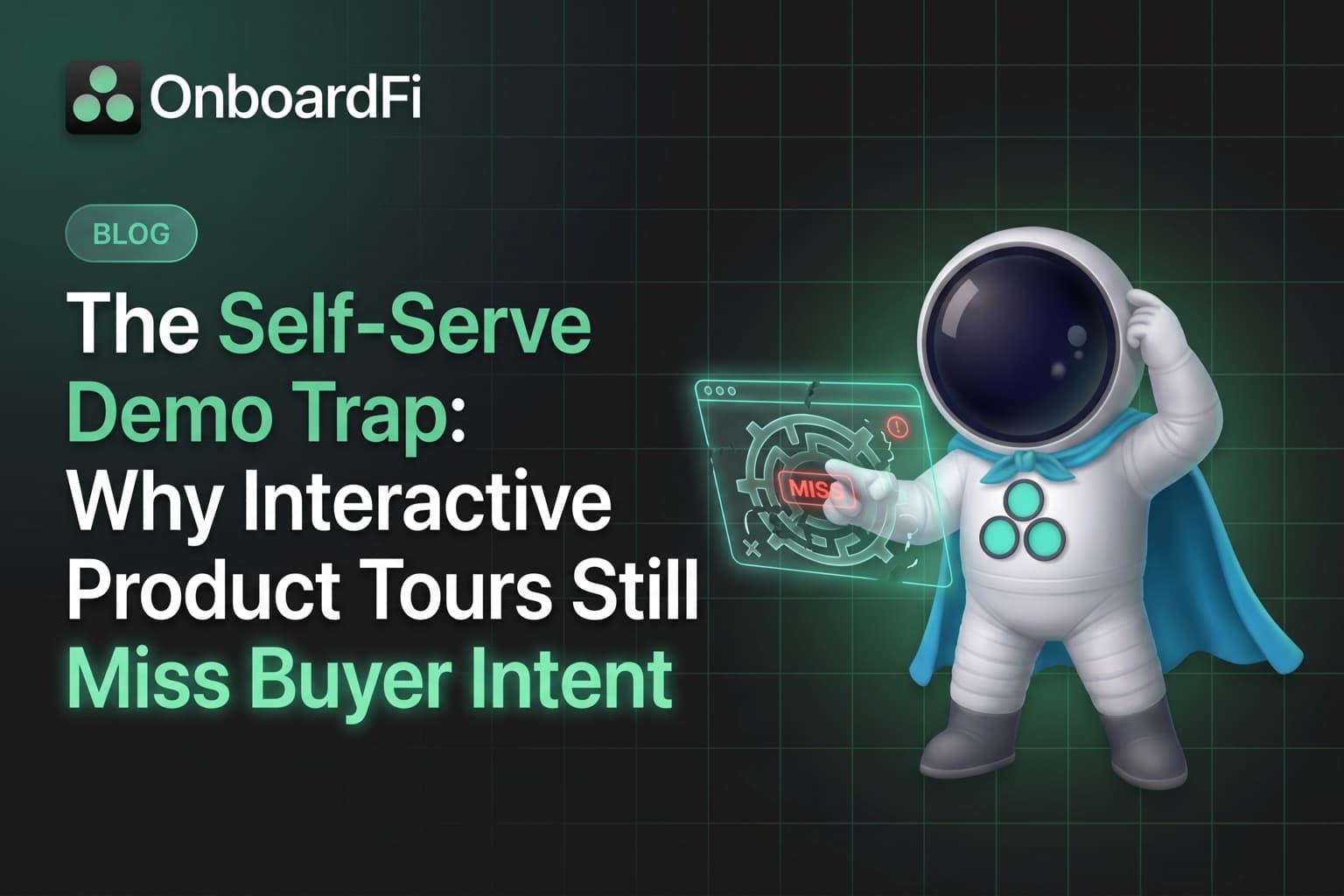
That is the self-serve demo trap: high surface engagement, low decision-grade intent.
Interactive Demos Solved Friction, Not Qualification
The market shift toward rep-free evaluation is real.
Gartner coverage summarized in Debriefing reports that 67% of B2B buyers now prefer rep-free experiences during evaluation: Gartner: 67% of B2B Buyers Now Prefer a Rep-Free Experience.
That demand is rational. Buyers want speed and control.
The mistake is assuming self-serve behavior automatically equals qualification depth.
A product tour can show where a buyer clicked. It usually cannot tell you:
- What business pressure is forcing change right now
- Which internal stakeholder can block the deal
- What implementation constraint will delay onboarding
- Why timing shifted from “this quarter” to “later”
Those answers live in conversation, not clicks.
The New Gap Is Context, Not Traffic
Many teams still diagnose pipeline problems as a volume problem.
It is now a context problem.
Recent GTM signals highlight the same pattern from different angles:
- HubSpot announced expanded AI agents and deal progression automation, reinforcing that platforms are racing from “recording” to “executing”: HubSpot Puts Growth Context to Work with New HubSpot AEO, AI Agents, Smart Deal Progression, and 100+ Updates
- Customer.io shipped a major AI-agent release for marketing workflow execution: Customer.io’s biggest product release: AI Agent and more
- Industry commentary continues to flag lead-gen disappointment even with higher spend: B2B companies keep investing in lead gen and keep hating the results
The throughline is simple: teams can generate interaction, but still fail to capture decision-ready context.
Why Product Tours Alone Underperform in Mid-Market and Enterprise
Self-serve tours are useful. They are just incomplete for complex deals.
1. They capture behavior, not intent language
A prospect can complete a tour and still be unqualified. Click paths do not explain urgency, budget politics, or cross-functional blockers.
2. They flatten stakeholder complexity
Enterprise deals are rarely one-person decisions. You need to know who owns implementation, security review, and success metrics. Static tours do not map that.
3. They create false confidence for handoff teams
Sales assumes “high engagement” means readiness. CS assumes sales captured requirements. Neither assumption is reliable when context was never explicitly collected.
4. They delay risk discovery
By the time the real constraints surface, you are already in late-stage evaluation or early onboarding. Recovery gets expensive.
This is the same execution failure pattern described in The Sales Execution Gap: Why Self-Updating CRMs Still Lose Pipeline: signals are present, but action quality lags.
What the Best Teams Do Instead
High-performing teams do not abandon self-serve. They layer conversation on top of it.
The operating model looks like this:
- Let buyers explore independently through tours and content.
- Trigger conversational qualification at moments of high intent.
- Convert conversation into structured, reusable context for sales and onboarding.
That third step is where most teams fail.
Without structured context, every handoff resets trust and slows momentum. With structured context, each stage starts ahead.
Conversational Enrichment Is the Missing Layer
OnboardFi’s thesis is not “replace self-serve.”
It is “complete self-serve with conversational enrichment.”
An Embedded Agent can capture what tours miss:
- The buyer’s actual objective in their own words
- The implementation timeline and constraints
- Stakeholder roles and buying stage
- Objections that need to be addressed before proposal
Then the Customer Portal carries that context into execution, so onboarding starts with preserved intent instead of reconstructed notes.
If your team already runs product tours, this is the practical upgrade path.
A Practical Qualification Workflow for 2026
If you want to keep self-serve velocity without sacrificing pipeline quality, run this workflow:
Step 1: Keep the tour, redefine the success metric
Do not score success as “tour completed.” Score success as “qualified context captured.”
Step 2: Trigger conversation at high-intent events
Examples:
- Tour completion on pricing-sensitive flows
- Repeat visits to comparison pages
- Demo requests from target accounts
Use conversational prompts to capture buying stage, decision process, and near-term blockers.
Step 3: Push context to execution surfaces
Route the captured context into your CRM plus onboarding workflow. If onboarding starts without that brief, treat it as an operational defect.
Step 4: Measure handoff quality explicitly
Track:
- Percent of opportunities with complete conversational brief
- Time from demo to first meaningful follow-up
- Time from close to first onboarding milestone
- Week-one stall rate for new accounts
This is how you connect top-of-funnel experience quality to downstream revenue outcomes.
The Strategic Implication
The winner in AI-led GTM will not be the team with the flashiest self-serve experience.
It will be the team that turns buyer interaction into execution-ready context faster than competitors.
That means moving beyond “did they engage?” to “do we know enough to execute well?”
Interactive demos matter. Rep-free buying is here. But a tour alone is not a qualification system.
Conversation is.
If you want to close the self-serve demo trap, deploy a conversational layer that captures intent, feeds sales, and carries context into onboarding without loss.
Start with OnboardFi Embedded Agent and connect it to your execution workflow in Use Cases: Sales.