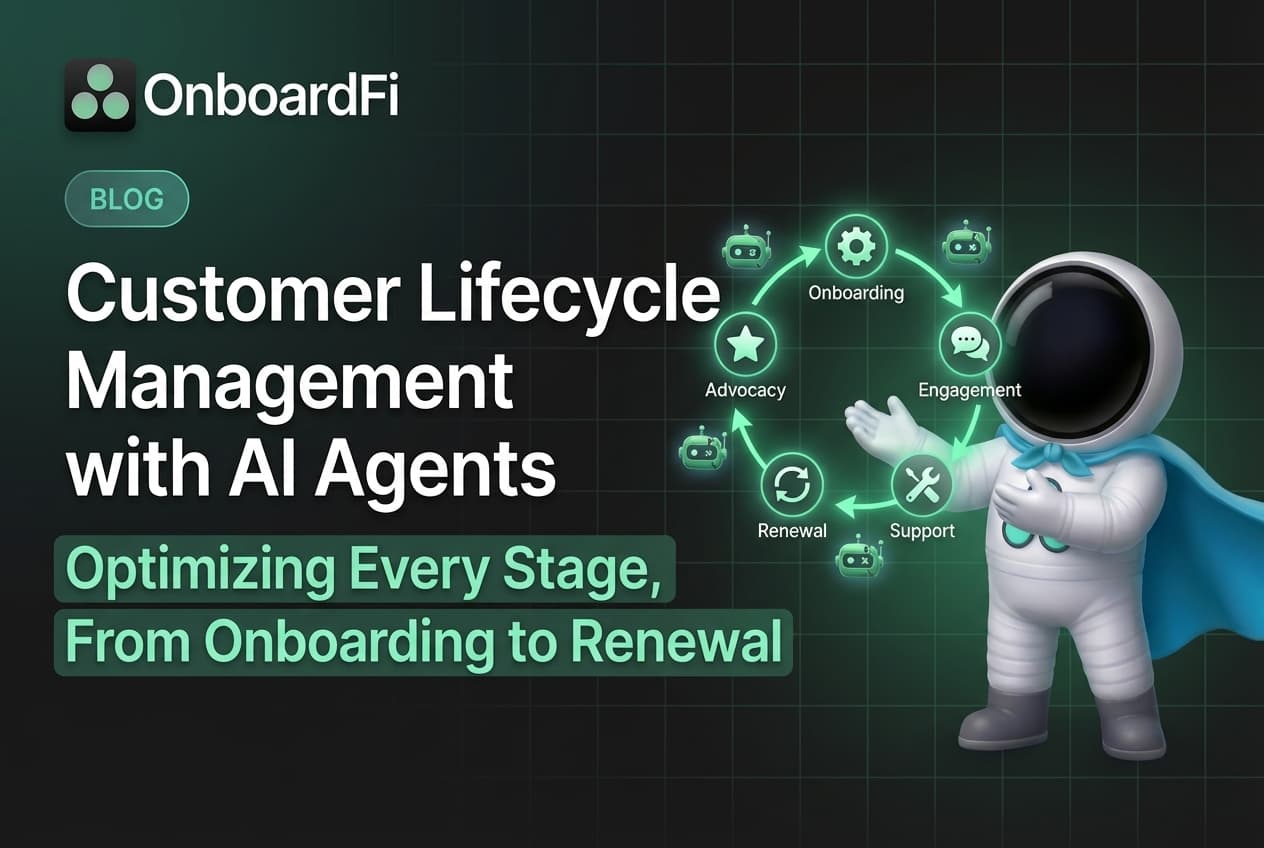
Customer lifecycle management is one of those concepts every B2B team understands in theory and almost nobody executes well in practice. The stages are well-documented — awareness, acquisition, onboarding, engagement, retention, advocacy. The frameworks exist. The playbooks are written.
So why does execution still fall apart?
Because CLM isn't a strategy problem. It's a labor problem. And AI agents are the workforce that finally closes the gap.
The Real CLM Bottleneck
According to Pega's breakdown of customer lifecycle management, CLM works by integrating marketing, sales, customer service, and analytics to optimize interactions across every stage. That sounds great on a whiteboard. In practice, it means someone has to:
- Follow up with every inbound lead within minutes, not hours
- Personalize onboarding flows based on what a prospect actually said during the sales process
- Monitor engagement signals across channels and act on them before churn sets in
- Reach out proactively when usage drops, not reactively after a cancellation
Each of these is a full-time job. Most companies can't staff all of them, so they prioritize one or two stages and let the rest decay. The result is a lifecycle that looks complete on paper but has massive execution gaps.
Where AI Agents Fit In
AI agents don't replace your CLM strategy — they execute it. Continuously. Across every stage. Without the staffing constraints that force you to choose which parts of the lifecycle actually get attention.
Here's what that looks like at each stage:
Awareness & Acquisition
Traditional CLM treats awareness as a marketing function — run campaigns, drive traffic, capture leads. The handoff to sales is where things start breaking. Leads sit in a queue. Response times stretch from minutes to hours to days.
An AI agent deployed as an embedded website widget changes this. It engages visitors in real-time conversation, qualifies them based on actual dialogue (not just form fields), and routes hot prospects immediately. No queue. No delay.
Onboarding
Onboarding is where most CLM strategies hit their first real wall. The promise is personalized, guided experiences. The reality is a generic email sequence and a knowledge base link.
AI agents handle onboarding the way a dedicated CSM would — walking each customer through setup, answering questions in context, adapting the flow based on the customer's specific use case. The difference is they can do this for every customer simultaneously, not just the top-tier accounts.
As MyDocSafe's guide on AI client onboarding notes, automating the client journey isn't just about efficiency — it's about consistency. Every customer gets the same quality of onboarding regardless of your team's bandwidth.
Engagement & Retention
This is where the labor problem becomes most acute. Engagement monitoring requires constant attention to usage patterns, support tickets, NPS scores, and communication frequency. Retention requires acting on those signals fast enough to matter.
AI agents can monitor these signals continuously and intervene proactively — sending a check-in when usage drops, offering help when a customer hits a friction point, or escalating to a human when the situation requires it. They turn retention from a reactive firefight into a systematic process.
Advocacy
The final lifecycle stage — turning satisfied customers into advocates — is the one most companies never get to because they're too busy firefighting retention. When AI agents handle the earlier stages consistently, your human team has the bandwidth to focus on deepening relationships with your best customers and building advocacy programs that actually work.
Interactive Demos: The CLM Accelerator
One of the most effective ways to deploy AI agents across the lifecycle is through interactive product demos. Rather than static sales decks or pre-recorded walkthroughs, interactive demos let prospects and customers experience your product in a guided, conversational format.
This applies to multiple lifecycle stages:
- Acquisition: Prospects self-qualify by engaging with a demo that adapts to their needs
- Onboarding: New customers learn by doing, guided by an AI agent that answers questions in real time
- Engagement: Existing customers discover features they haven't explored yet through contextual demos
OnboardFi's guide agent is built specifically for this — creating interactive demo experiences that serve as touchpoints across the entire lifecycle.
The Agentic Web and CLM's Future
The emergence of what Anuradha Weeraman calls the "Agentic Web" — where AI agents interact with web services on behalf of users — is accelerating the CLM transformation. Protocols like WebMCP are giving agents standardized ways to access and act on information across platforms.
For CLM, this means AI agents won't just operate within your product. They'll coordinate across your entire tech stack — pulling data from your CRM, acting on signals from your analytics platform, and engaging customers through whatever channel they prefer. The lifecycle becomes truly connected, not just conceptually integrated.
What This Means for Your Team
Deploying AI agents across the customer lifecycle doesn't mean eliminating your human team. It means redeploying them to where they create the most value:
- Strategic relationship management with high-value accounts
- Complex problem-solving that requires judgment and empathy
- Product development informed by the customer success insights your AI agents surface
The grunt work — the follow-ups, the check-ins, the qualification calls, the onboarding walkthroughs — that's where AI agents excel. Let them handle the volume so your team can handle the complexity.
Getting Started
If you're evaluating how AI agents fit into your CLM strategy, start with the stage where your execution gap is widest. For most companies, that's either:
- Lead response time — If prospects wait more than 5 minutes for engagement, an embedded agent closes that gap immediately
- Onboarding consistency — If only your top accounts get white-glove onboarding, AI agents can extend that experience to every customer
- Retention signals — If you're only catching churn after it happens, continuous monitoring changes the game
The technology is ready. The frameworks have been ready for years. The only thing that was missing was the workforce to execute them. AI agents are that workforce.
OnboardFi helps B2B companies deploy AI agents across the customer lifecycle — from first-touch qualification to long-term retention. See it in action or explore our client portal guide to learn more.