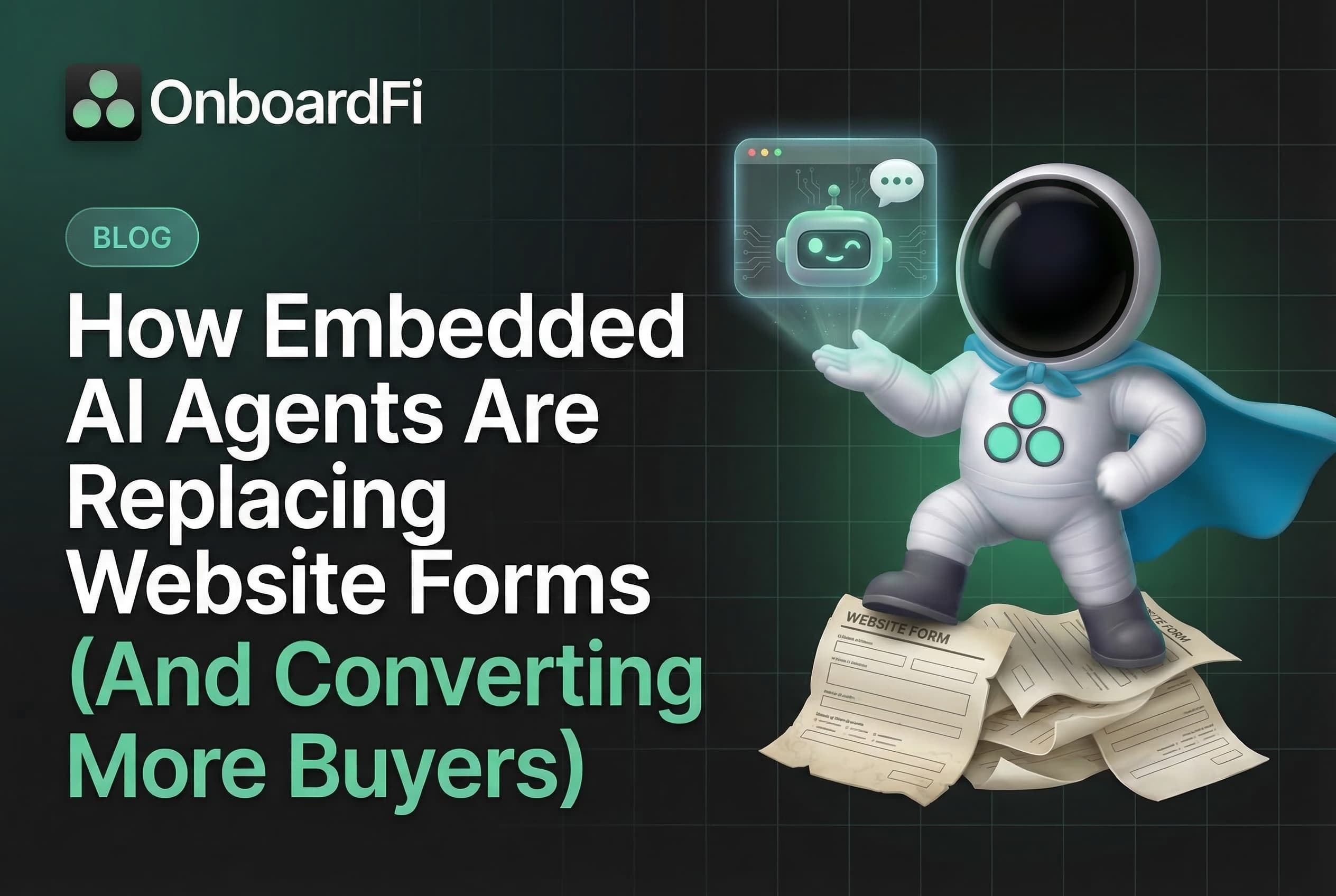
Your website has a form problem. Not a design problem — the form looks fine. Not a copy problem — the headline is sharp. The problem is the form itself.
Web forms were designed for a different era of buying. They assume the visitor is ready to commit: name, email, company, phone number, "what are you looking for?" — submit. Wait. A rep calls two days later, reads from a script, and hopes they caught the buyer in the right mood.
That model is collapsing. B2B buyers are now 70% through their evaluation before they make contact. By the time someone hits your demo request form, they've already read the G2 reviews, compared you to three competitors, and half-decided. The form adds friction at the worst moment — right when intent is highest.
Embedded AI agents change the equation. Instead of asking buyers to submit a form and wait, they engage in the moment: answer questions, handle objections, qualify fit, and route the right leads to the right humans — while the page is still open.
The Zapier analysis of 10,000 AI-powered workflows found that nearly one-third of all business AI automation is now built around lead management — capturing, qualifying, and routing prospects automatically. The category isn't experimental anymore. It's infrastructure.
Key Takeaways
- Web forms capture who contacted you; embedded AI agents capture why — and that difference determines deal quality
- AI-powered website conversion tools are now ranked ahead of traditional chatbots and form-based flows for B2B qualification
- Platforms deploying coordinated AI agents across sales touchpoints are reporting 30% faster deal cycles and 42% higher sales productivity
- The shift from form to agent is not a UX upgrade — it's a fundamental change in how intent gets captured and routed
The Form Was Always a Proxy for Conversation
Here's the underlying logic of a contact form: "We can't have a real conversation with every visitor, so we'll collect enough information to have a conversation later."
That compromise made sense when scale required it. It doesn't anymore.
Embedded AI agents can have that conversation now — at scale — across every visitor simultaneously. Not a scripted chatbot that routes to "talk to sales." A genuine qualification conversation that understands context, adapts to what the buyer is actually asking, and routes with precision.
The Docket.io ranking of AI conversion tools distinguishes between two fundamentally different architectures: tools built around structured playbooks and routing logic (a more sophisticated form) versus agentic AI capable of "free-form reasoning and adaptive qualification." The second category consistently outperforms the first — not because the technology is flashier, but because buyers respond differently when the conversation feels real.
This is the gap traditional forms cannot close: they capture demographic data. AI agents capture intent, context, and objections — the information that actually moves deals.
What Changes When You Replace the Form
1. Qualification Happens in Real Time
The classic form-to-sales workflow has a latency problem. A prospect submits at 11 AM. The SDR sees it at 2 PM. They send a follow-up email at 3 PM. The prospect responds the next morning. By that point, three competitors have already had a live conversation with them.
An embedded AI agent qualifies at the moment of peak interest. It asks the right questions, understands the answers, and either schedules a meeting immediately or routes to the right human with a complete conversation summary — not just a filled-out form.
Fractal's Flyfish.ai platform, which now deploys 35+ coordinated AI agents across the sales lifecycle, has documented 30% faster deal cycles and 42% higher sales team productivity in early enterprise deployments. The productivity gain doesn't come from automating busywork — it comes from surfacing qualified buyers with context already in hand.
2. Objection Handling Doesn't Get Deferred
Web forms are intentionally passive. They can't handle the question your buyer is actually thinking: "How does this compare to what we're already using? Can it integrate with our CRM? What's the typical time to implementation?"
Those questions determine fit. When a buyer can't ask them in the moment, they either leave or submit a form with unresolved doubts — which creates a skeptical lead, not a qualified one.
Embedded agents handle these questions live. They're trained on your product, your integrations, your competitive positioning. A buyer who asks "how does this compare to [competitor]?" gets a real answer, not "let me connect you with someone who can help."
The Docket.io analysis specifically tested how AI conversion tools respond to "layered questions about pricing, integrations, security, and fit" — and found that agentic systems designed for adaptive qualification consistently outperformed chatbot-style tools that route rather than engage.
3. Buyer Context Travels with the Lead
One of the most underappreciated costs of the form model: context dies at the submit button.
A rep gets a lead with a name, email, and a vague field that says "interested in automation." They have no idea what the buyer actually asked about, what objections they raised, or how far along their evaluation is. Every conversation starts from scratch.
With an embedded AI agent, the full conversation context — what they asked, what concerned them, what they confirmed they already understood — travels with the lead. The rep enters the first human conversation with a real picture of where the buyer is in their evaluation.
This is the difference between a warm handoff and a cold call that happens to have a form submission attached.
The Architecture Behind It
Effective embedded AI agents aren't just conversational — they're integrated into the systems that drive revenue. The best implementations connect to CRM to enrich and create records in real time, pull from product documentation to answer technical questions accurately, integrate with scheduling to book meetings without a human in the loop, and route leads based on qualification criteria rather than geography or round-robin.
The Rover model — "DOM-native" agents that live inside your website rather than on top of it — represents the technical direction: agents that can read the page context, understand what a visitor is looking at, and respond to the specific moment rather than delivering a generic script.
Monday.com's announcement of dedicated AI agent onboarding infrastructure signals something broader: enterprise software platforms are rebuilding their architecture to accommodate AI agents as first-class participants in workflows, not integrations bolted onto forms.
What This Means for Your Funnel
The shift from form to embedded agent isn't a point solution. It changes the upstream economics of your entire acquisition model.
Top of funnel: Visitors who engage with an agent convert at higher rates than visitors who bounce off a static form. The agent captures intent that would otherwise leave the site.
Middle of funnel: Leads arrive pre-qualified, with context. Reps spend less time on discovery and more time on deals that are actually ready to advance.
Bottom of funnel: Faster deal cycles because objections were handled earlier. Fewer lost deals because the buyer had their questions answered before skepticism hardened.
This compounds. A 20% improvement in lead quality affects every stage of the funnel downstream.
Where OnboardFi Fits
OnboardFi's embedded agent is built specifically for this workflow — qualifying buyers at the top of the funnel and carrying that context through the full customer lifecycle.
The embedded agent doesn't just capture contact information. It understands who the buyer is, what they're evaluating, where they're stuck, and what it would take to move forward. That context feeds into customer lifecycle management from day one — not after a disconnected form submission starts a new CRM record.
The result: buyers who engage with an embedded agent arrive at first conversation better informed, with less skepticism, and with a shorter path to close.
The Practical Transition
If you're moving from a form-first to an agent-first acquisition model, a few implementation principles matter:
Train on specifics, not generalities. An agent that knows your integration list, your pricing tiers, and your competitive differentiators is fundamentally different from one trained on generic marketing copy. Specificity drives trust.
Design for handoff, not just capture. The agent's job isn't to close the deal — it's to hand off a better-prepared buyer to a human at the right moment. Define what "qualified" means and build routing logic around it.
Preserve the conversation. Make sure the full agent conversation travels to your CRM, your rep's inbox, and anywhere else that needs to know what the buyer actually said. Context is the asset.
Measure the right things. Don't compare form submission rates to agent engagement rates. Compare lead quality: how many conversations advance to pipeline, how fast, at what close rate.
The Form Isn't Going Away Immediately
To be clear: web forms won't disappear overnight. There are still workflows — content downloads, newsletter signups, support tickets — where a form is the right tool.
But for high-intent, high-value interactions — demo requests, product inquiries, qualification conversations — the form is increasingly the wrong tool. It was always a workaround for the inability to have a real conversation at scale. That limitation no longer exists.
The companies winning on website conversion in 2026 aren't optimizing their forms. They're replacing them.
Ready to see how an embedded AI agent handles buyer qualification on your site? Try a live demo or talk to us about your setup.